Monday 1st February
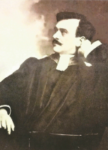
The Esk and Liddle* Fisheries Association held its annual meeting, chaired by John Milne Home, the Duke of Buccleuch’s chamberlain (head of household) and factor (land agent). Salmon and trout catches last year were disappointing, due to unusually dry weather during the fishing season.
* The spelling of Liddle is now usually ‘Liddel’.
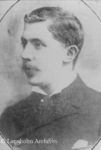
The North United Free (‘UF’) Church held its annual business meeting and soiree. It reported increased membership, increased attendance at prayer meetings, a credit balance, six new Sabbath School teachers, good fundraising by the Townhead Literary Society (which usually meets at the church) and keen interest by the youth in the League of Young Worshippers, a national movement.
Tuesday 2nd February
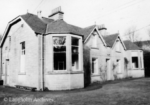
The Eskdale Infectious Diseases Hospital held a board meeting, chaired by John Milne Home. The hiring of a general servant was approved to enable the matron Jane Hogg to devote more time to patients.
Wednesday 3rd February
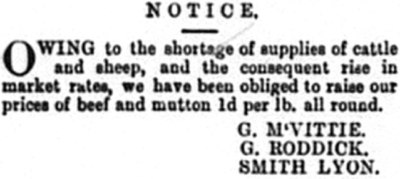
The town’s three butchers issued a joint notice about an increase in prices.
Saturday 6th February
The delayed semi-final and final of the annual open carpet bowling tournament took place in the Douglas Hotel, watched by a large number of spectators. It was won by a team consisting of two players from Langholm and two from nearby.
Sunday 7th February
Prizes for good attendance at the Parish Church Sunday School were handed out by Robert Hamilton, rector of Langholm Academy.
Tuesday 9th February
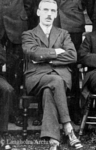
David Anderson, a shepherd from the Ewes valley, gave a talk to the Townhead Literary Society on ‘William Knox, the Sacred Poet, and His Poetry’. Knox (1789-1825) wrote one of Abraham Lincoln’s most cherished poems, Mortality (O, Why Should the Spirit of Mortal be Proud?). Knox made an unsuccessful attempt at farming at Wrae, near Langholm, and frequently visited Archibald Scott, a banker who lived at Clinthead, now the home of Major Edward Bell.
Wednesday 10th February
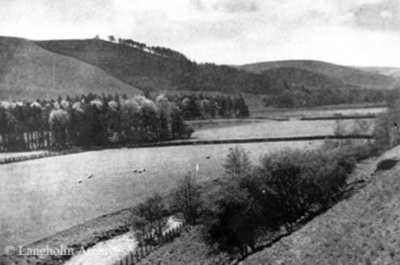
Numerous houses and rooms are being advertised for rent in the the E&L, partly due to the outflux of soldiers. Some are available immediately; others are from Whitsunday (15th May for Scottish property valuation purposes).
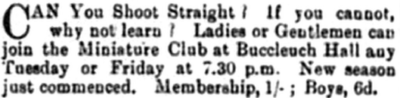
The Miniature Rifle Club is advertising for new members (‘miniature’ meaning small bore):
Thursday 11th February
The Miniature Rifle Club held the first of two target shooting competitions against Carlisle Ladies (20 rounds per person at 25 yards). The ladies were ahead at the half-way stage but lost with a score of 1,327 to 1,373.
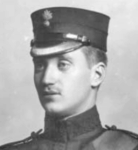
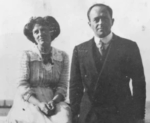
Lord Francis Scott, youngest son of the late Duke of Buccleuch, married Lady Eileen Elliot, eldest daughter of the fourth Earl of Minto, at Wellington Barracks, London. He was on crutches, still recovering from a war wound received in October 1914. The bridge and groom received a brooch and cufflinks as wedding gifts from King George V, made of diamonds and enamel. Francis Scott’s full surname is Montagu Douglas Scott and Eileen’s is Elliot-Murray-Kynynmound.
The Town Council introduced strict new water bye-laws ‘with the view of preventing any waste, misuse, undue consumption, or contamination’.
Monday 15th February
Esk and Liddle Fisheries Association waters opened today but there was little success due to poor weather.
Tuesday 16th February
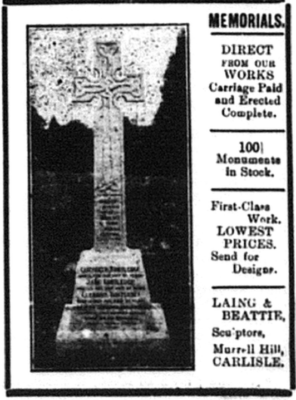
David Beattie, sculptor and poet, gave a lecture to the Townfoot Literary Association on ‘Hymns Old and New’, accompanied by music and illuminated slides. Charles Paisley, tanner, presided, commenting that Mr Beattie had written over 60 hymns.
Friday 19th February
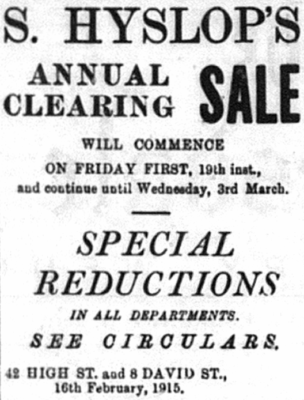
Draper Simon Hyslop is holding a clearance sale until Wednesday 3rd March:
Saturday 20th February
In the return shooting match between the Rifle Club and Carlisle Ladies, held at Waterton Hall, Carlisle, the ladies won 1,308-1,297.
The number of voters in the UK was published, giving a figure of nearly 8.4 million (just under 20 percent of the total population), of which nearly 885,000 are in Scotland (around 18 percent of Scotland’s population). See here for an article on voting rights.
Tuesday 23th February
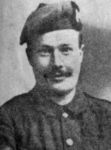
Lawson Cairns, son of James Cairns, co-owner of Ford Mill, is with 1st/9th Royal Scots in Edinburgh. He started a diary today, aware that he is probably heading for the front line. ‘We were wakened at 5 a.m. and told to be ready to move at a moment’s notice. […] We fell in at 6.00 p.m. & marched to Princes Street Station where we entrained for Southampton.’
Wednesday 24th February
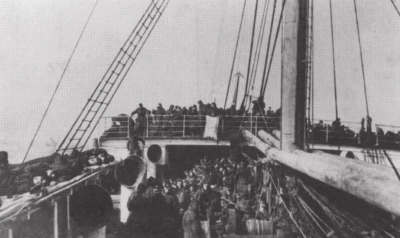
From Lawson Cairns’s diary: ‘The ship was called The Inventor & was used as a cattle boat, so you can imagine what comfort there would be for us! We went on board at 1.00 p.m.’
The Langholm Women’s Work Party has made nearly 600 items for soldiers so far, including socks, mufflers and mittens.
Friday 26th February
From Lawson Cairns’s diary: ‘… we arrived outside Harvre [Le Havre] harbour at 4.00 a.m. […] Left for the next camp about midday & had a very stiff march up hill all the way.’
A memorial to Captain Robert Scott (1868-1912), who died at the age of 43 while leading an expedition to Antarctica in 1912, was unveiled in Portsmouth harbour by Admiral Sir Hedworth Meux (pronounced ‘mews’). The statue was made by Scott’s widow Kathleen Bruce (1878-1947), who studied under the French sculptor Auguste Rodin. Scott was also leader of the 1901-1904 Discovery Expedition to Antarctica in which Shackleton participated.
Saturday 27th February
From Lawson Cairns’s diary: ‘We were then issued with goats’ skin coats & entrained in cattle trucks, 36 men to each. Saw Mr McLean Watt at the station & had a word with him.’ Rev Lauchlan Maclean Watt is minister of St Stephen’s, Edinburgh, and chaplain to the Gordon Highlanders. While in Le Havre, he used to go down to the quay and play his bagpipes for arriving Scottish regiments until he was banned by the authorities.