1. Kitchener’s appeal
On 7th August 1914, three days after the UK declared war on Germany, Secretary of State for War Lord Kitchener appealed for young men aged 19 to 30 to reinforce the army. The age limit was higher (45) for ex-soldiers and was soon raised to 35 for new recruits.
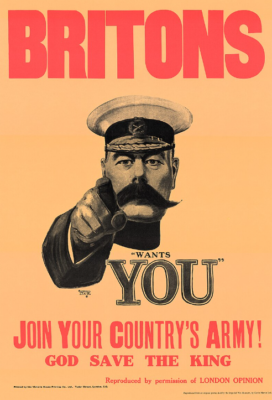
Although they were volunteers (until conscription began in March 1916), they were to be trained to join the ‘regular’ army, as distinct from the Territorial Force which consisted of part-time volunteers organised mainly on a county basis, typically serving only in the UK. Kitchener’s recruits were sometimes referred to as the ‘New Army’ or ‘Kitchener’s Army’.
2. The Derby scheme
On 11th October 1915, Kitchener appointed Edward Stanley, 17th Earl of Derby, as director general of recruiting. Five days later, Stanley launched the ‘Group Scheme’, commonly known as the ‘Derby Scheme’. Men between 16 and 41 were asked to ‘attest’, i.e. join up immediately or commit to joining up later if called upon.
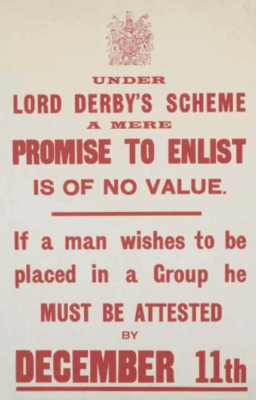
An advantage of attesting was an element of choice about which unit to join, which was largely lost when conscription was implemented. Another possible advantage (as advertised below) was the deferment of decision-making to local tribunals, potentially relieving individuals in tense situations between employers and the military.

Those who had attested could wear a specially-issued khaki armband, indicating their willingness to serve, although an E&L article indicates ambivalence about doing so:
[…]
Around 320,000 men attested, which was insufficient, and the Military Service Act of January 1916 introduced conscription in March 1916.
3. Prior enlistment
Langholm already had a number of men in the regular army and an active local Territorial unit. Some in the town had fought in South Africa in the Second Boer War (1899-1902), including two who re-enlisted and died in the Great War:
- James Dalgliesh (1879-1915): former tailor; killed in the Gallipoli campaign.
- David Wallace (1870-1915): son-in-law of William Douglas, proprietor of the Eskdale Temperance Hotel; killed in the August Offensive in the Gallipoli campaign.
4. Call-up
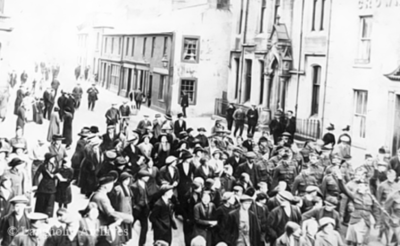
A week after the declaration of war, existing Langholm Territorials were called upon to report for training in Dumfries with one day’s notice. In the morning of Thursday 13th August they gathered at the Buccleuch Hall under the command of Lieutenant James McGeorge, a solicitor in his father’s firm Dobie & McGeorge, and made their way to Market Place. The town band led them from there to the railway station to catch the 7.10 am train, sent off by many townsfolk.
5. Roll of Honour
The local newspaper, the Eskdale & Liddesdale Advertiser, developed a Roll of Honour of those with links to Langholm and nearby places. By January 1916, there were 474 listed under Langholm, belonging to a wide variety of units. Many were with the King’s Own Scottish Borderers (KOSB), which focussed on Dumfriesshire for its recruitment.
The vast majority of Langholmite recruits were privates, one of several ‘other ranks’ (non-officers). Officers included Major Edward Bell and 2nd Lieutenant James McGeorge. See here for an overview of ranks.
| Unit | Other ranks | Officers | Total |
|---|---|---|---|
| King’s Own Scottish Borderers | 140 | ||
| Army Service Corps | 31 | ||
| Gordon Highlanders | 27 | ||
| Canadian Corps | 25 | ||
| Royal Scots | 23 | ||
| Black Watch | 15 | ||
| Yeomanry | 15 | ||
| Royal Army Medical Corps | 12 | ||
| Royal Engineers | 12 | ||
| Royal Garrison Artillery | 12 | ||
| Navy | 12 | ||
| Others | 150 | ||
| Total | 474 |
See here for an overview of military units, including the above. For a searchable/sortable list of units and individuals, see Roll of Honour.
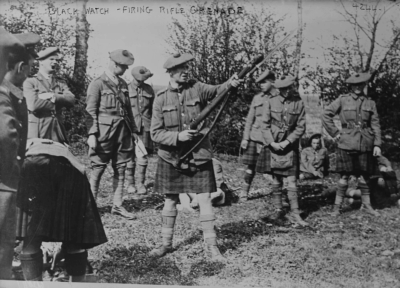
Volunteers had significant latitude in the choice of which regiment they joined. They were influenced by factors such as their family members’ previous military service, styles of uniform (particularly kilts in Scotland) and which regiment their friends and relatives were joining. Some parts of the country had ‘Pals battalions’ formed from particular communities, including the 11th Border Regiment (also known as the Lonsdale Battalion) which was formed in nearby Carlisle, which several Langholm residents joined. The KOSB was in some respects a proxy for a Pals battalion in the Langholm area.
Kilts were worn by some Highland regiments early in WWI, including in battle, such as the Gordon Highlanders and the Black Watch. However, they were largely replaced by trousers as more effective protection when chemical weapons began to be used.
< The Great War … Home support >