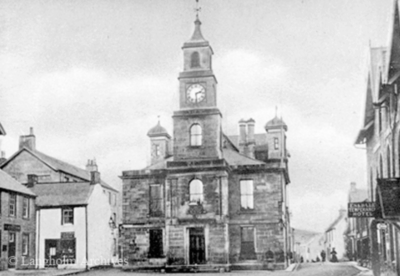
The town council, also known as the burgh council, met monthly in the burgh chamber of the town hall, on the first floor* in the photo below, to the right of the clock tower.
* Second floor in North American terminology.
Its main functions in 1915 can be seen from its committees: Lighting, Cleansing, Water, Public Health, Roads and Bridges, Fire, Finance, Sewage Purification and Private Streets.
Its primary concerns that year were:
- Surfacing of some of the town’s roads (see 11th March in the Diary).
- The resignation of junior bailie Alexander Montgomery after being accused by Provost Easton of vote-rigging (see 8th April in the Diary). He was not replaced until the following year due to war disruption.
- A legal case brought by Dumfriesshire County Council against the town for the amount of sewage discharged into the river, although the proceedings were deferred, again due to war disruption (see 10th June in the Diary).
Its officials consisted of a provost (mayor and magistrate), two bailies (magistrates), five councillors and a clerk:
- Provost: Thomas Easton, grain merchant.
- Senior bailie: John Cairns, Ford woollen mill co-owner.
- Junior bailie: Alexander Montgomery, hairdresser (resigned in April 1915).
- Councillors:
- John Goodfellow, painter.
- James Harkness, coal agent.
- Edward Armstrong, manager at Buccleuch woollen mill.
- Arthur Laidlaw, tweed designer.
- Major Edward Bell, director of Buccleuch woollen mill (on leave of absence for war service).
- Clerk: George Irving Bell, solicitor.
The magistrates adjudicated in three types of local court:
- Police. Most cases involved drunkenness, theft, assault, damage or public disturbance. Judgements typically involved a fine, or alternatively a short custodial sentence for those who were unable or unwilling to pay the fine.
- Licensing. This court met half-yearly to issue or renew various types of licences, including for public entertainment, lodging houses, cinematography and sale of poisonous sheep dips.
- Appeals. Property valuations were made every year for the purpose of charging rates. Valuations could be challenged within a certain time period but were rarely successful.
The town hall was constructed in 1811 on the site of an old tollbooth. It contained meeting rooms and, after Langholm became a police burgh in 1845, also a court room and prison cells. The cells were superseded by those in the new police station in the 1890s. The hall was originally commissioned and owned by the Duke of Buccleuch and was granted to the town in 1894.
The clock in the bell tower was illuminated from 1886. In the same year, a statue of Sir Pulteney Malcolm, which used to stand in front of the building, was moved to the front of the adjacent Library building to create more space in Market place, much to the ire of some of the local residents.
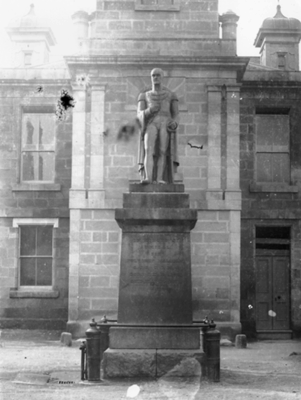
Original position of the Sir Pulteney Malcolm statue