Langholm Cricket Club is a few hundred yards from the site of Langholm Lodge (mostly demolished in 1954), a hunting property owned by the Duke of Buccleuch, which he occupied each summer and/or autumn with his family and guests.
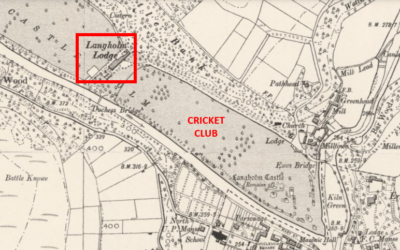
Some of the Duke’s family and guests played in matches between the Lodge and the Club, and some of the family played regularly for the Club. Like the Rugby Club ground, the Cricket Club’s pitch was on the Duke’s land.
Most first-class matches in cricket-playing nations were cancelled during the Great War. Many club matches continued, but Langholm cancelled all of its play.
In 1914, Langolm Cricket Club officials included three of the Buccleuch family:
- President: 6th Duke of Buccleuch (died in November 1914).
- Vice-presidents:
- Lord Dalkeith (7th Duke of Buccleuch from 1914); president of Marylebone Cricket Club, the sport’s worldwide authority.
- Lord Whitchester: Lord George Scott, third son of the 6th Duke.
- Frederick Berkley Matthews of Westerhall estate.
- Richard Graham of Holmwood: woollen mill manufacturer and brother of Fred Graham (below).
- Captain: Fred Graham, woollen mill manufacturer (Reid & Taylor).
- Vice-captain: Rev David Inglis, Chalmers United Free Church.
- Secretary and treasurer: Walter Mitchell.
- Committee: J N Duncan, J Clark, John Fletcher, W Elliot, J Hotson, J Liddle.
Lord Dalkeith presented two bats to Langholm Cricket Club annually as a prize for those who came top in the season’s batting and bowling averages.
Below is the batting scorecard for Langholm Lodge against Langholm Cricket Club on Tuesday 9th September 1913, the 82nd birthday of the 6th Duke of Buccleuch. It includes five lords and two ‘honourables’ (nobility rather than House of Commons titles).*
* See here for a brief introduction to UK titles.
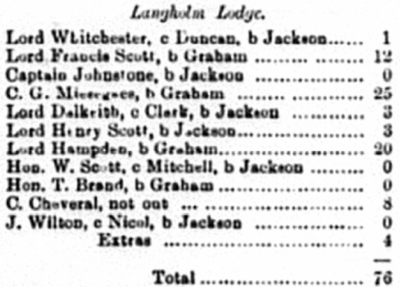
The players above include:
- Lord Whitchester: the Duke’s third son, George; first class cricket player.
- Lord Francis Scott: the Duke’s sixth son; see 11th February 1915 in the Diary about his marriage; later a settler in Kenya.
- Captain Johnstone: possibly a member of the Johnstone family, formerly of Westerhall, Westerkirk.
- Carl Miesegaes: son of local ‘gentleman farmer’ Ary Miesegaes.
- Lord Dalkeith: the Duke’s second and eldest surviving son, John; 7th Duke of Buccleuch from 1914 to 1935.
- Lord Henry Scott: the Duke’s fourth son; first class cricket player.
- Lord Hampden: the Duke’s son-in-law, Thomas Brand, 3rd Viscount Hampden, married to the Duke’s daughter Katherine Scott.
- Hon W Scott: probably the Duke’s grandson William, second son of Lord Dalkeith. If it had been Lord Dalkeith’s first son Walter (8th Duke of Buccleuch from 1935 to 1973), he would have been described as Lord Eskdaill.
- Hon Thomas Brand: the Duke’s grandson, son of Lord Hampden later 4th Viscount Hampden.
The jacketed captain below in the front row with the dog is Fred Graham, co-owner of woollen mill Reid & Taylor. Behind his left shoulder is John Scott, 7th Duke of Buccleuch. Behind his right shoulder is Rev David Inglis of Chalmers United Free Church, a regular player.
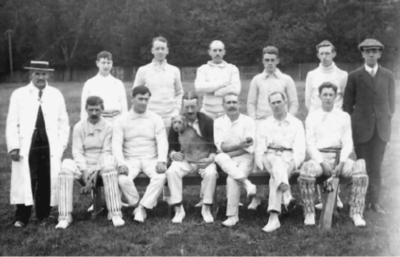
Lord George Scott, younger brother of the 7th Duke of Buccleuch, played first class cricket, including for the Gentlemen (amateurs) against the Players (professionals).
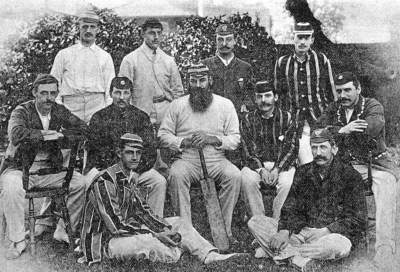
Numerous international and first-class players lost their lives in the war. Langholm Cricket Club lost Lieutenant Corporal William Elliot at the Battle of Loos, a wool sorter at Buccleuch mill (see 29th September 1915 in the Diary).
1915 also saw the death of W G Grace from a stroke, aged 67: see 23rd October in the Diary. He was a leading voice in late 1914 for the cancellation of cricket matches.
In 1914, Langholm’s opponents were St Boswells, Upperby, Carr’s Athletic (Carlisle), Lockerbie, Hawick and Wilton, Annan, Dumfries, Denton Holme and the Cameron Highlanders B Company.
William Jackson, millworker, topped the 1914 batting averages and Alex Morrison, blacksmith, the bowling averages. The low batting averages compared to today’s typical club figures are indicative of the poor quality batting surfaces of the era, unprotected from the elements and also used, for example, by Langholm for a dance in 1914 prior to a match.

< Lawn bowls … Curling >