The history of ‘modern’ curling is largely attributed to Scotland, with its oldest dated curling stone being from 1511. The worldwide spread of the activity largely followed Scottish emigration, particularly to Canada. The first official rules were developed by the Royal Caledonian Curling Club, Edinburgh, founded as the Grand Caledonian Curling Club in 1838.
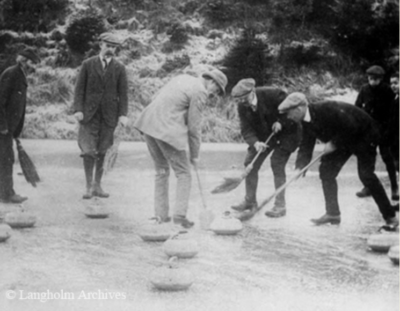
The first Scotland versus England international was in 1895 at Talkin Tarn lake near Brampton, on the English side of the border, won by Scotland.
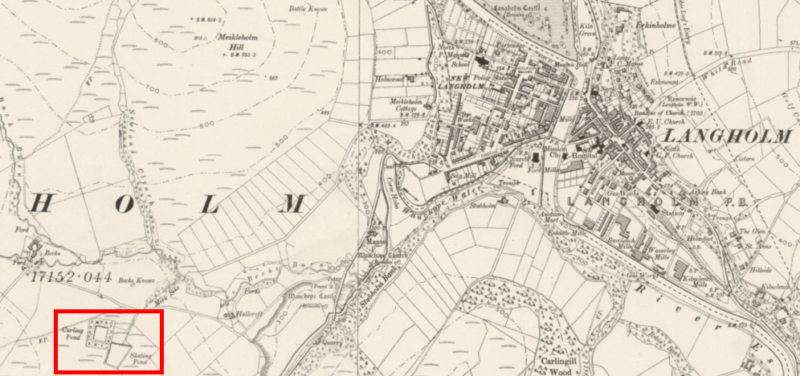
Langholm’s curling pond was about a mile out of town, next to a skating pond.
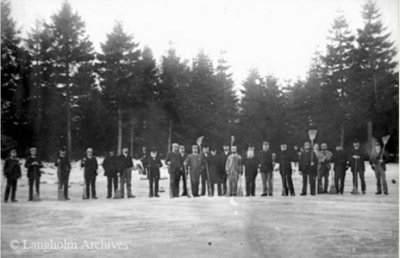
The local club was referred to at different times as the Eskdale Curling Club and the Langholm Curling Club. Below is the Langholm Curling Club medal, awarded in sporadic years, due to war disruption and possibly due to varying weather conditions. Winners include:
- 1912: Robert McGeorge, solicitor.
- 1913: Walter F Scott, woollen designer.
- 1926: J(ames?) McGeorge. If so, son of Robert above and a lieutenant with 1st KOSB in the war.

There was minimal play in 1915-1916. The club’s patron and officers were:
- Patron: vacant; formerly the 6th Duke of Buccleuch (died in 1914).
- President: Robert McGeorge, solicitor.
- Vice-president: John Cairns, bailie (magistrate) and co-owner of the Ford Mill, in place of Henry Sanders, draper, who died in 1914.
- Secretary and treasurer: William Hyslop, mason/builder.
- Representative members:
- James Cairns, co-owner of the Ford Mill.
- William Milroy, ironmonger.
- Chaplain: Rev James Buchanan.