- Town band
- Pipe band
- Flute band
- Milligan’s band
- Allison’s band
- Choirs
- Langholm Amateur Dramatic Society
- Visiting orchestras
- Other musical events
There was no shortage of music in the town, with three town bands (brass, pipe, and flute), two private bands (Milligan’s and Allison’s), various choirs, an amateur dramatic society and visiting orchestras. Wartime fundraisers often involved songs and instrumentals.
1. Town Band (brass)
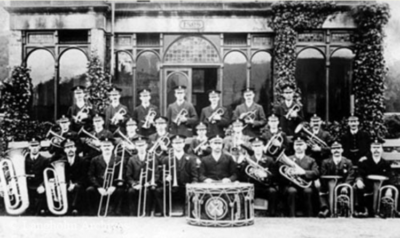
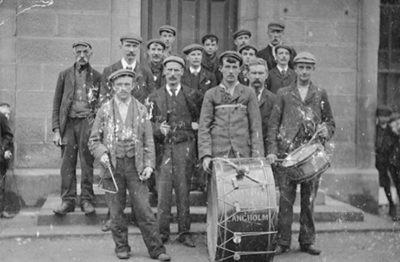
The Langholm Town Band is the oldest brass band in Scotland, having started in 1815. It competes in regional and national competitions.
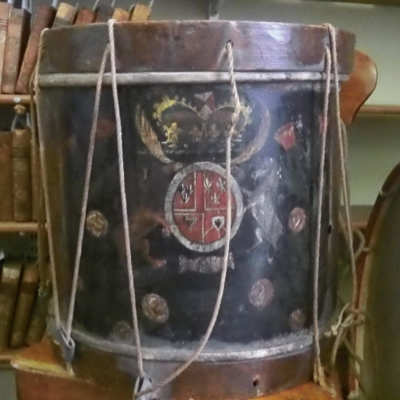
The band played for the Royal Scots Greys as they marched through the town on their return from Waterloo to Edinburgh in 1815. It is believed that the drum below was used on that occasion and is possibly somewhat older.
2. Pipe Band
The band was formed in 1900 and performs at various events throughout the year, both in the town and further afield.
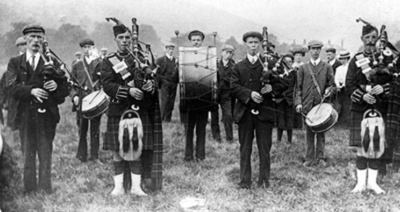
A pipe band typically consists of bagpipes and three types of drum: bass, snare/’side’ and tenor (the latter are not in the photo above).
3. Flute Band
The flute band plays an important role during the Common Riding, parading to the railway station on the night before the main event to welcome exiles back to the town.* The next day it rouses the town very early in the morning with a musical parade through the streets.
* Although the station was closed in the 1960s, the band still parades to its former location.
4. Milligan’s band
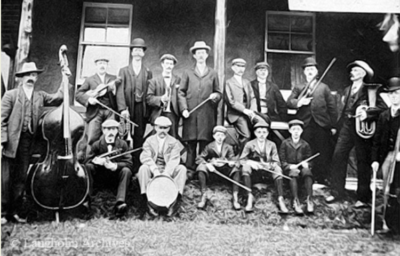
The Milligan family owned Buccleuch Hall and had a band which performed there at events and during silent movies. The band was also available for hire for weddings, concerts and private parties.
5. Allison’s Band
Allison’s band (sometimes called Allison’s Orchestra) was led by violinist Joe Allison, on the right in the photo below.
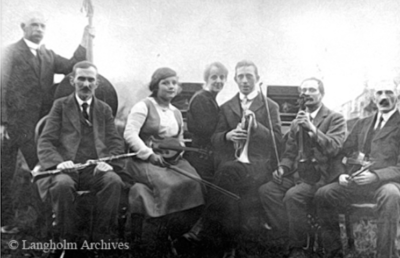
Left to right:
- W Fletcher. Possibly William (1869-1942), wool scourer, not closely related to the Fletchers below.
- William Taylor (1879-1950), confectioner.
- Euphemia Fletcher (1884-1946), housekeeper. Daughter of Isabella (below).
- Isabella Fletcher nee Irving (1854-1919), widow of John Fletcher, loom tuner.
- Her sons William (1888-1917) and Jackson (1896-1918) were killed in the war.
- Her son James (1884-1923), greengrocer, died at age 39.
- Her son-in-law John Ewart was Common Riding cornet in 1903 and Langholm provost in 1940-1948: see Freemasons.
- T Boyd. Possibly Thomas (1891-1962), joiner.
- J Irving.
- Joe Allison (1876-1937), woollen pattern weaver.
6. Choirs
There were six churches with choirs, including the Parish Church which employed an organist and choirmaster, Charles Metcalfe. Charles was born in Carlisle and was previously a professor of music in London. His father William was an organist for Trinity Church, Carlisle, and had musical associations with Langholm.
The International Order of Good Templars also had a choir, which in 1915 performed a musical in the EU Congregational Church as a fundraiser for buying regalia.
7. Langholm Amateur Dramatic Society
LADS staged musicals periodically in the Buccleuch Hall, but did not perform during the war. It later became the Langholm Amateur Operatic and Dramatic Society (LAODS).
8. Visiting orchestras
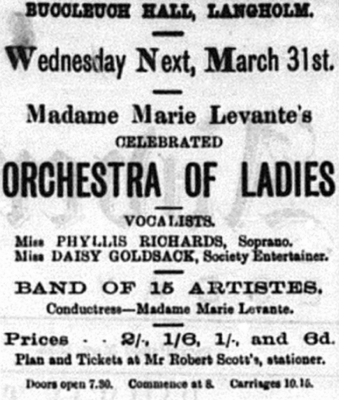
Larger-scale performances in 1915 were mainly by visiting companies, including Madame Marie Levante’s internationally known Orchestra of Ladies (see 31st March in the Diary).
9. Other musical events
Various organisations arranged ‘soirees’ and other events as entertainment and/or fundraisers, often incorporating a musical component. These included a concert to celebrate the first anniversary of the Red Cross Hospital on 16th October 1915.