Reid & Taylor’s operation (‘The Factory’) was in the New Town, with its main building facing the River Esk.
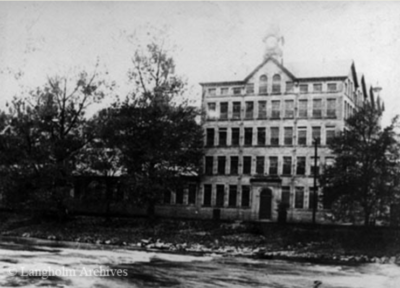
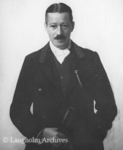
During the war it was owned and operated by Richard Graham (1874-1918) and his younger brother Fred (1878-1933). Richard ran the mill while Fred was serving with 1st Lothians and Border Horse in France, but died after a short illness in 1918, leaving it in Fred’s hands.
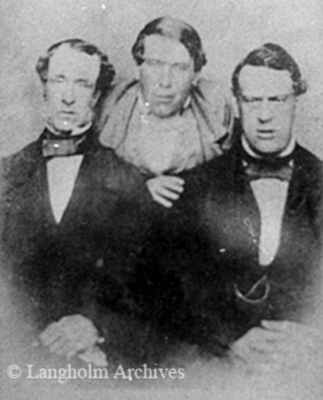
The original premises were established by T & A Renwick and were expanded considerably by David Reid (1776-1858) and his son Alex (1813-1874), with financing from Cumbrian merchant and draper Joseph Taylor (1820-1896).
By 1874 it was a large multi-building complex.
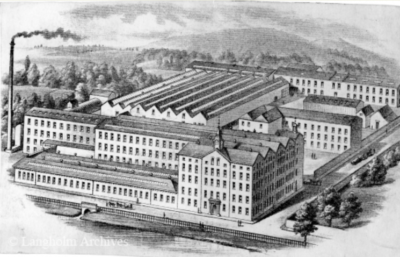
The photo below shows a different angle, looking from the New Town towards the Old Town.
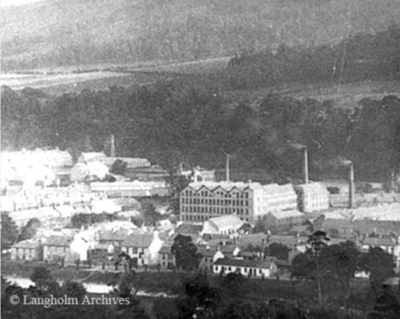
After Alex Reid and Joseph Taylor died, the company was run by Henry Graham (1846-1909), generally believed to have been Taylor’s illegitimate son. By the time of the Great War, it had passed to his sons Richard and Fred.
Like his brother, Fred died at relatively a young age without children, and the business passed on to the energetic and artistic Robbie Scott-Hay (1906-1965). He developed it into a high-end cloth manufacturer (‘the world’s most expensive twist suiting’) with fashion shows and its own art gallery. The shows were continued and expanded by John Packer who staged international extravaganzas.
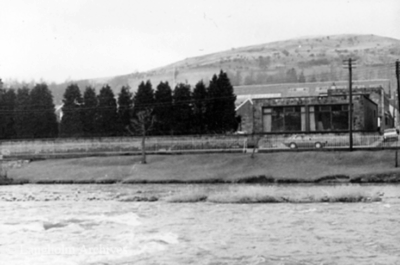
Reid & Taylor was bought by Allied Textiles, a Yorkshire conglomerate, in 1964, and entered a collaboration with S Kumar Brothers of India in 1998. Production moved to S Kumar’s facilities in India in 2011 and the mill closed in 2013.
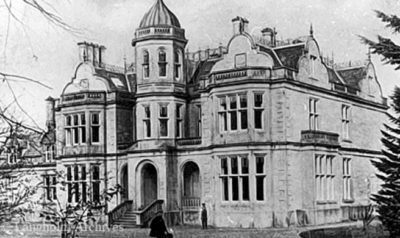
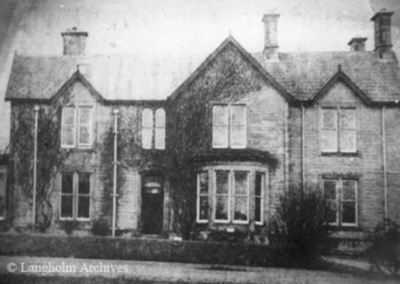
Reid & Taylor income contributed to two of Langholm area’s large houses: Craigcleugh (1874), built by Alexander Reid, and Holmwood (1885), built by Henry Graham. However, Reid died before Craigcleugh had been completed.
< Woollen mills … Waverley mill >