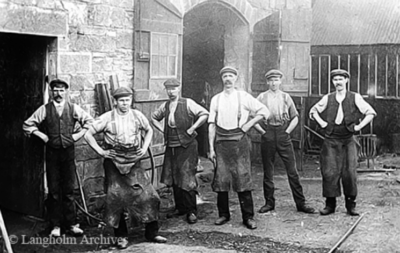
There were two main blacksmith workshops:
- John Ewart: Parliament Square
- Robert and David Jeffrey: Drove Road
In addition to their regular blacksmith activities, John Ewart also undertook cycle repairs and both businesses did farrier work (horseshoeing).
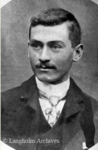
John Ewart (1880-1950) was a second generation blacksmith whose father Lawrence died aged 52 when he was five. The business was then run by John’s mother Isabella until John took it over. Lawrence’s younger brother James also worked in the business.
James’s son, also James, was killed in the Battle of the Somme in September 1916. He was a tailor and was serving with 2nd King’s Own Scottish Borderers.
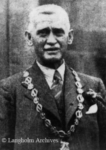
John was cornet in 1903 and provost in 1940-1948.
In Lawrence’s time, the business specialised in ploughs, such as the one in the photo below. Meanwhile, across in Indiana, USA, a native of the neighbouring Liddesdale valley was developing the ‘cold-chilled’ plough using a fast-cooling method of casting the metal blades. James Oliver (1823-1908) developed this into a multi-million dollar business which used the slogan ‘plowmaker of the world’ (American spelling).
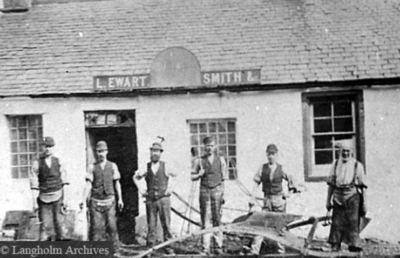
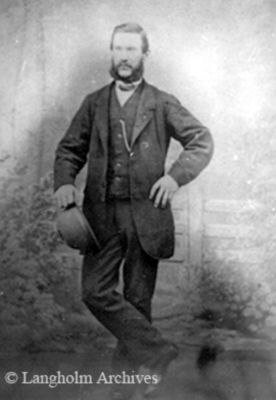
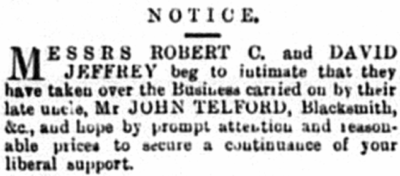
The Jeffrey brothers Robert (1878-1933) and David (1884-1948) had a blacksmiths’ workshop off Drove Road which belonged to their uncle John Telford until he died in March 1915.
In the photo below Robert is third from left and David is on the right.