- Introduction
- Background
- Suffragists
- Suffragettes
- Wartime activities
- Local newspaper content
- Effectiveness
1. Introduction
2. Background
In the early 1800s, only about 10 percent of men could vote, mainly aristocratic property owners, and no women.
Suffrage (the right to vote) was only one issue in relation to political participation: other issues included lack of or distorted representation, financial barriers to being a member of parliament (‘MP’), coercion affecting voting, and corruption.
‘Chartists’ (supporters of the People’s Charter of 1838) campaigned for universal adult male suffrage, secret ballots, no property qualification to be an MP, pay for MPs, equally sized constituencies and annual elections.
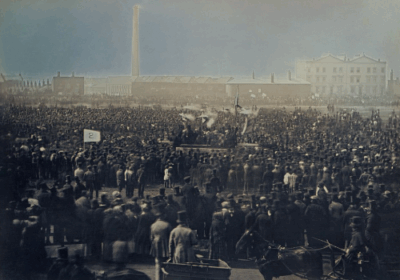
Although the Chartists were suppressed, some reforms took place and by 1900 nearly 60 percent of adult males could vote but with a property restriction and still no women. Only men could be MPs.
3. Suffragists
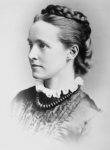
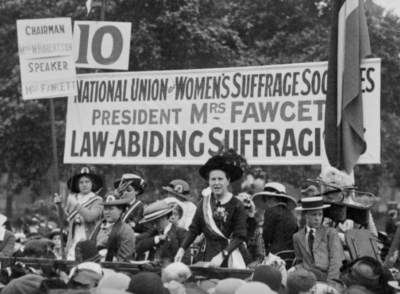
The National Society for Women’s Suffrage (‘NSWS’) was formed in 1867 by scientist Lydia Becker. Millicent Garrett (later Millicent Fawcett) joined the same year, becoming the head of its successor, the National Union of Women’s Suffrage Societies (‘NUWSS’), in 1897. Its members were generally known as ‘suffragists’.
The suffragists used legal means and were keen to highlight this to disassociate themselves from the ‘suffragettes’.
4. Suffragettes
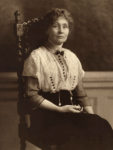
Emmeline Pankhurst became disillusioned with slow political progress and formed the Women’s Social and Political Union (‘WSPU’) in 1903, with the motto ‘Deeds not Words’. Pankhurst’s branch was described in 1906 as ‘suffragettes’ by Daily Mail journalist Charles E. Hands and the WSPU adopted the nickname.*
* The ‘-ette’ suffix indicates a diminutive, feminine and/or imitation form of a word; Charles E. Hands used the term ‘suffragette’ in a derogatory way. It was avoided by suffrage campaigners in many other countries, notably the USA, to avoid its possible pejorative use. Few UK ‘suffragettes’ had qualms about adopting the term. Other groups have also embraced initially disparaging descriptions, such as ‘Tories’, originally used to refer to anti-Cromwell Irish outlaws, and ‘Whigs’, originally used to describe anti-Catholic Scottish cattle-drovers.
The suffragettes’ methods became increasingly violent, stopping short of loss of life, but sometimes only by chance. Their aim was suffrage on the same basis as men, which excluded much of the working class at the time, i.e. ‘Votes for Women’, another slogan of the WSPU. effectively meant ‘Votes for Some Women’.
For some stories about the suffragettes, see here. They include bombings; arson; attacking people with whips, pepper and a hatchet; breaking windows; slashing works of art; etc.*
* Simon Webb claims that ‘History has been kind to the suffragettes’ (p. xi of The Suffragette Bombers), considering the level of violence that they used.
5. Wartime activities
Both the suffragists and suffragettes suspended the main aspects of their suffrage campaigns to support the war effort. They encouraged women to work in factories, on farms and in auxiliary services, partly due to awareness that this could result in greater appreciation for female contributions to society, ultimately resulting in a higher likelihood for female suffrage.
6. Local newspaper content
The following excerpts are examples of contemporaneous opinions in the Eskdale & Liddesdale Advertiser, without comment, except for context. The content may well be biased towards the views of the publisher Walter Wilson, although in other contexts (e.g. letters to the editor) he allowed for differences of opinion.
2nd April 1913
Poem by pen-name “DLORAH” of Langholm:
“THE SUFFRAGETTE.”
In every paper you happen to get
You’ll read about the “Suffragette.”
That female warrior, fearless and strong
Marching to war with ranting song.
Armed to the teeth with hammer and stick,
Or, hid in her bag lies a massive brick
Ready to hurl at some window pane
If only the “Franchise” she may gain.
Policemen she treats with unconcern,
Her power of endurance they’ve yet to learn;
They march their battalions through the street
With banners aloft, and scurrying feet.
“Votes for women,” they loudly cry,
“We will win our cause, or, fighting, die.”
With faces of martyrs, and eyes blazing fire,
What poor “mere man”* can withstand their ire!
They march along on destruction bent
Though many, jail toils, have underwent,
The only way to tire them out
Is to jail them for ever without a doubt.
And then perhaps (?), some peace we’d get
When we see the last of the “Suffragette.”
* This phrase suggests an awareness of Sir Almoth Wright’s letter to the Times (see below).
8th October 1913
From an anonymous syndicated article entitled ‘London Letter’ (a regular piece in the E&L):
Sir Almroth Wright, when he published his famous anti-Suffragette letter to the Times a short while since [28th March 1912], raised a perfect hornets’ nest of feminine protest about his ears. His latest, expanded presentation of the case for the ‘mere man’ is likely to provoke attack hardly less virulent and violent…
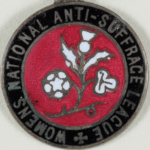
Sir Almroth Wright (1861-1947) was an immunologist whose letter was republished as a pamphlet by The National League for Opposing Woman Suffrage, founded in 1910, incorporating the former Women’s National Anti-Suffrage League (‘WNASL’).
18th February 1914
From an anonymous writer in the ‘Women’s Gossip’ section:
HOPELESS POSITION OF WOMEN’S SUFFRAGE.
The new Session sees the cause of woman suffrage in a more hopeless position than ever. Militant methods have alienated public support, and whilst there was a majority in the House of Commons in favour of votes for women, it has now been turned into a minority. The women’s cause, so far as this Parliament is concerned, is dead. and so long as militant tactics are pursued, the public will not discriminate between those sections which advocate these methods, and those who repudiate them. If public support is to be won back, the movement requires to be released from this incubus, instead of which a new organisation calling itself “The United Suffragist”* has been formed in London, which can only have the opposite effect. This seeks to make the best of both worlds by leaving militancy an open question. No one will be asked to become a militant, and no one will be dissuaded from doing so, so that it will help still further to associate in the public mind, all societies constitutionally advocating the cause of woman suffrage, with the discredit which militancy has brought upon it. There are no doubt people who find a certain satisfaction in the record of the outrages and destruction wrought by the militants, but nothing is more certain than that these insane tactics are putting back the clock, and deferring the day when public opinion will support women’s claim to the vote.
* The United Suffragists was a breakaway group from the militant WSPU, permitting non-militants and men to join.
17th June 1914
From an anonymous syndicated article entitled ‘London Letter’ (a regular piece in the E&L):
Many people are asking themselves whether militant suffragettes who defy the law should be allowed to die in prison? It is a tragic thing that such a question should be possible, and yet the outrages which have been, or are being comitted, has caused many people to approve the policy of allowing women who refuse food to suffer the extreme penalty of their act. Something must be done. Matters have now reached such a pitch that stern efforts must be made to suppress the campaign of arson and vandalism. It we could treat women the same as men, we could soon put an end to the burning of churches and the attempts to blow up historic buildings, but we must recognise the fact that this is impossible. Neither deportation, or the “let-them-die” policy is practicable, but if the wealthy subscribers to the militant funds are proceeded against, something may be done to kill the conspiracy at its source. Most of the so-called “martyrs” are in the pay of a wealthy organisation, and the people who supply the funds should also be called upon to share the risks.
2nd September 1914
Some museum and art displays had been closed due to attacks by suffragettes. From an anonymous writer in the ‘Women’s Gossip’ section:
WOMEN’S ACTIVITIES.
One of the indirect results of the war is the re-opening of the museums and art galleries. All our internal dissensions are healed by the common peril, and it is to be hoped that it will put an end once and for all to the war which the militant suffragists have so long waged on Society. Nearly all the women’s social organizations have turned themselves into Public Service Corps. The National Union of Suffrage Societies has placed all its numerous branches at the disposal of the local councils for the relief of distress, and in some or other way the women of every town, and almost every village, are busy with various schemes of social aid and service. No doubt a good deal of this labour will run to waste by reason of overlapping and want of organization. If more shirts and other garments are made than can possibly be required, it will only mean taking the bread out of the mouths of factory girls and others engaged in the ready made clothing trade. What is wanted is some central organization which will direct without discouraging the efforts of willing helpers.
7. Effectiveness
There has been much debate about the relative effectiveness of the law-abiding suffragist versus the militant suffragette movements. The militant suffragettes gained more publicity but their use of violence caused a backlash, to some extent against both movements.
World War I was a turning point with considerable societal change including high female employment in traditionally male jobs. Also, many soldiers returning from the war would not have had a vote without legislative change. Again, there has been much debate about the relative effectiveness of these factors compared to pre-war campaigning for female suffrage.
The Representation of the People Act gained royal assent in February 1918 and gave the vote to all men over 21 and to about two thirds of women (those over 30, with a property condition).
Nine months later, the Parliament (Qualification of Women) Act 1918 enabled women to stand for election as MPs.
Voting was extended to all women over 21 in 1928.