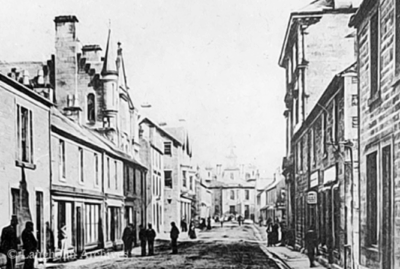
28 High Street
Fish supplies diminished due to the Royal Navy’s requisitioning of many fishing vessels to act as minesweepers, submarine spotters and patrol boats. Also a significant amount of fishing was curtailed due to the threat from German mines and submarines.
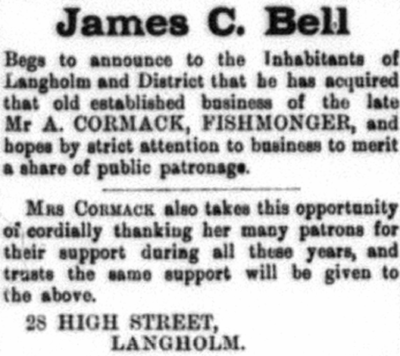
James C Bell (1887-1956) was the son-in-law of Alexander Cormack and took over Alexander’s fishmonger business after his death in October 1915.
Alex Cormack’s son, also Alex (1887-1932), was a carpenter and had emigrated to Canada, joining the Canadian Expeditionary Force in the war.
James’s daughter Margaret (‘Madge’) (1912-2015) married Drew Stevenson in 1937, founder of the Edinburgh Woollen Mill, a successor to Waverley mill.
In the Golf Club’s centenary booklet A Round of a Hundred (1992), author Wattie Bell tells a story about James:
J. C. Bell won some prominence as a scratch and low handicap golfer and along with his wife [Elizabeth], Langholm Ladies Champion, and his daughter, Madge (Mrs Stevenson), several times Champion, the trio could hold their own with the best from either side of the Borders.
But it was not for his prowess as a golfer that J. C. Bell was a local hero among the boys of Langholm. It was because he was the local fishmonger and his cry of “fine fresh herring”, echoed around the streets of Langholm for many a year as he wheeled his cart around the town.
His great attraction for the boys was because he sold fresh herring at 1/2d each, and if their mothers bought one he would cut off the head and tail, gut it, and give the guts to the boy. Now herring guts is the favourite food of the eel and they can smell them for miles around (downstream). The boys would catch them on a large bait hook and 10 yards of line for a 1d at Drummond Andersons, the watchmaker on the High Street. There was a retired English exciseman called Williams who lived at the Stubholm House above the park who ate eels and would pay 1d each for them. Unfortunately, they had to be the large black sea eels which could grow to over 2 feet in length (he wouldn’t touch the local pale green eels), and they had to be alive when one arrived at the house.
However, it was discovered that if one held it by the head (to avoid it banging on the ground) and ran all the way, the creature would still be alive on arrival. One had to be careful that it did not entwine the legs on the steep climb behind the park, or a nasty fall could entail.
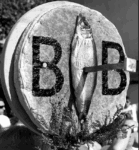
Herrings have a particular place in Langholm custom, with a salted herring being part of one of the emblems in the Common Riding, nailed to a barley bannock (a type of bread).
Much of the UK’s herring catch used to pass through Pulteneytown in Caithness, northeast Scotland, designed by Thomas Telford (1757-1834) who grew up in Eskdale and worked in Langholm for a while. Pulteneytown was named after Sir William Pulteney (1729-1805), formerly William Johnstone, who was also from an Eskdale family.
< Cycles … Co-op general store >