1. Water
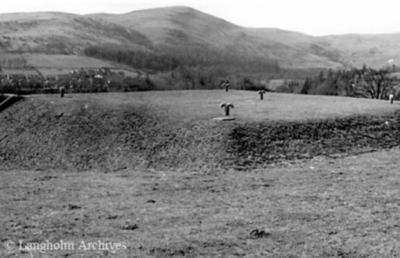
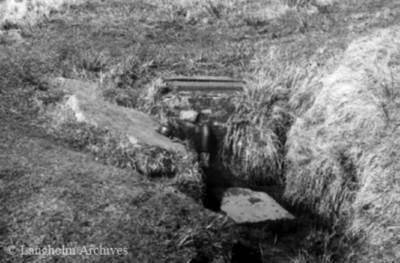
Langholm had a good piped water supply, sourced from a spring on Whita Hill overlooking the town. A new cistern was built in 1913, enabling 24-hour supply, whereas previously the supply sometimes had to be turned off overnight in the summer months to allow the old cistern to refill.
Strict new water bye-laws were introduced by the Town Council in 1915 ‘with the view of preventing any waste, misuse, undue consumption, or contamination’. It covered applications for water and specifications for service pipes (from the mains to individual properties), domestic cisterns, baths, water closets, urinals, stop-cocks, taps, etc.
Water from Whita Well was the subject of a near-riot in 1852 when townsfolk objected to the use of the well by Langholm Distillery and diverted a watercourse, resulting in conflict with the police.
2. Sewage
Much of Langholm was connected to the underground sewer system which underwent extensions and improvements each year, e.g. the addition of a sewer to Eskdaill Street in 1914.
An action was brought in November 1913 by Dumfriesshire County Council against the Langholm Town Council under the Rivers Pollution Prevention Act 1876, seeking to prevent sewage discharge by the Town Council into the Esk and its tributaries.
The Sheriff began: ‘Suppose we start practically with the admission that there is the sewage of 3,000 people going in to the river’, to which the Town Council’s advocate, Mr A D Morton of Edinburgh, responded: ‘Oh, yes; I can’t deny that.’ His defence, however, was that there was no harmful pollution after the sewage was diluted by the river.
Eventually a settlement was made in mid-1916 that was dependent on the Ministry of Munitions making a contribution to the cost of sewage treatment, as the new Gretna munitions settlement required water from the Esk. The ministry refused, so no sewage treatment was required but the Town Council incurred £1,000 in legal fees, which it recuperated from ratepayers.
3. Gas
Gas was introduced in the late 1830s, supplied by the Langholm Gas Company, later the Langholm Gas Light Company. ‘Town gas’ (as opposed to ‘natural gas’) was produced by heating coal in the absence of oxygen.
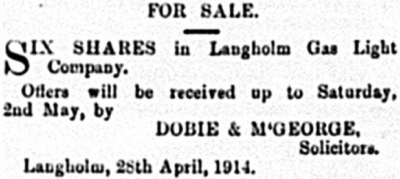
Some of the shares in the gas company were owned by the public and came up periodically for resale via local solicitors:
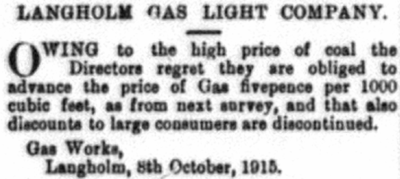
The price of gas was raised twice in 1915 due to the increasing cost of coal.
4. Electricity
Electric lighting was introduced to Edinburgh in 1881 but it was not until the 1930s or later when many rural towns gained access to a public electricity supply. Langholm investigated supply in 1914 but this was deferred due to the war and a public scheme was eventually installed in 1930, after which individual entities could convert their lighting and power from gas, e.g. the Parish Church installed electric lighting in 1932, soon followed by broad domestic use.
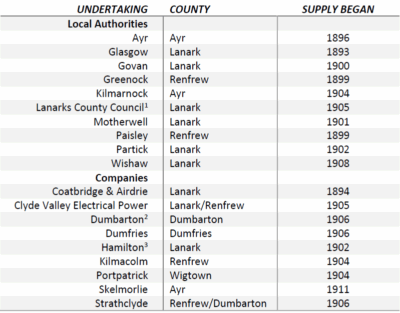
The Dumfries scheme was implemented by the India Rubber, Gutta-Percha and Telegraph Works of Silvertown, London, whose main business had been undersea cables (see the telegraph cables section of The World in 1915).
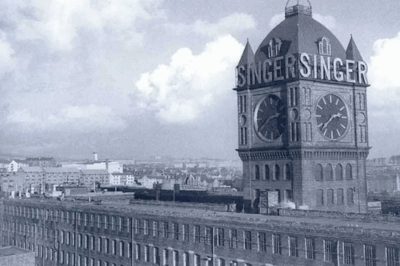
Prior to public supply, many organisations installed their own private generators, such as the large Singer sewing machine factory in Clydebank.
Private generation was also developed on a small scale from the 1880s, including by mills in the Scottish borders. The first electricity generation in Galashiels was at Buckholm corn mill in 1884 and in Hawick at William Elliot & Sons’ hosiery mill in 1900, both by hydropower.
The E&L reported in 1913 that many of the electricity-generating engines in the mills in Galashiels were becoming outworn, indicating that they had been broadly used in the woollen and other mills for some time.
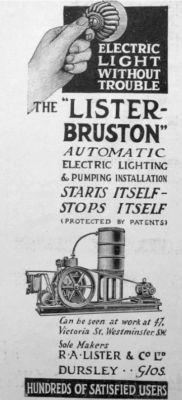
Small petrol generators became widely available in the 1910s. Canonbie public hall, for example, was opened in 1913 with a Lister-Bruston installation which was activated automatically when the lights were switched on.
The Ais Gill train disaster in northwest England in 1913 killed 16 people, partly from a fire resulting from gas lighting, prompting questions about the need for conversion to electricity. The issue of fire from gas ignition was even more significant in the 1915 Quintinshill rail disaster (see 22nd May in the Diary).
The Thomas Hope Hospital commissioned its own generator in 1926, becoming a relatively early adopter of electricity among cottage hospitals. A much earlier pioneer in this field was the Crighton Royal Hospital in Dumfries in 1894.