John Street
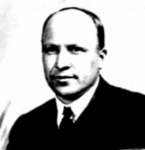
Tom Morrison (1875-1957) sold and repaired cycle cars, motor cycles and bicycles.
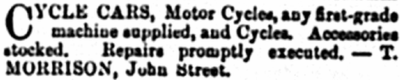
A ‘cycle car’ was a low-cost motorised vehicle for one or two people, with the driver usually sitting in the rear if it could take a passenger.
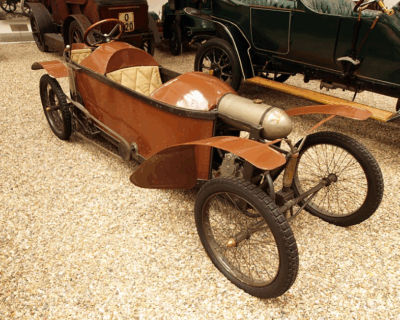
One of the main manufacturers was Trumbull of Connecticut, USA, but its factory was converted to make munitions. Co-founder and president Isaac Trumbull died when the Lusitania was sunk (see 7th May in the Diary), on the start of a sales trip to Europe with 20 cycle cars, hoping for many new orders. His brothers then decided to manufacture munitions instead of cycle cars.
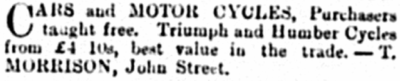
Tom offered free lessons for purchasers of cycle cars and motor cycles. Motor vehicles and drivers had to be registered but there was no test for driving competency.
Leading motorcycle manufacturers in the UK were:
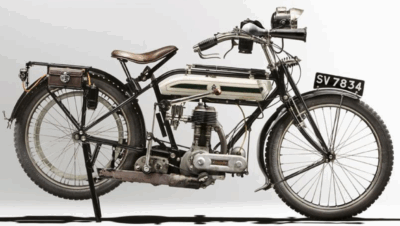
- Triumph (Coventry, Warwickshire): founded by Siegfried Bettman (1863-1951) from Nuremberg, Germany, who was mayor of Coventry in 1913-14. Its main military and civilian motorcycle was the Model H (the ‘Trusty Triumph’).
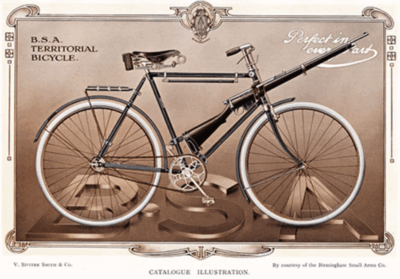
- BSA (Birmingham): the Birmingham Small Arms Company was a conglomerate that manufactured firearms, motorcycles, bicycles, tools and many other products (see also Miniature rifle shooting and Alcohol).
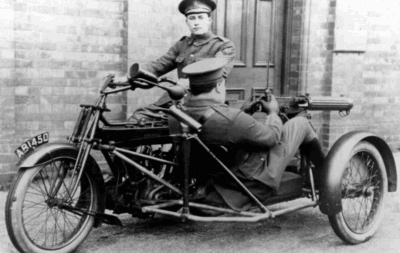
- Royal Enfield (Redditch, Worcestershire): its model 140 had a 425 cc engine with 3 horsepower (‘hp’). It had a military 6 hp version with a sidecar fitted with a Vickers or Maxim machine gun. The sidecar could be easily detached.
In the photo below, the Royal Enfield sidecar machine gun is rear-facing, but there were also forward-facing versions.
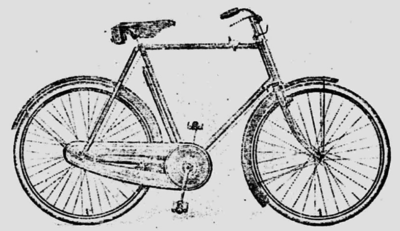
Tom sold mainly Triumph and Humber cycles.
Large manufacturers such as BSA included military models in their range which were more sturdy and had a fitting to carry a rifle.
Tom started as a blacksmith before going into the cycle trade. He sometimes described himself as a ‘cycle maker’ which typically means assembling parts provided by manufacturers.
His first daughter died in infancy and his second daughter was born in 1914.
Nearly all manufacturers stopped making cycle cars in the 1920s as mass production of standard cars made them much more affordable for ordinary people.
Competency tests for driving licences were introduced in 1935 for all those who started driving after 1st April 1934.
< Chemist … Fishmonger >