Monday 1st March
The Langholm School Board discussed an offer from a former pupil, David J Beattie, sculptor and poet (see 16th February), to donate a sundial to the school, which was accepted with thanks.
Tuesday 2nd March
Edward Harkness, deputy of the Langholm Lodge of the International Order of Good Templars, gave a talk in the EU Church to lodge members about alcohol prohibition. He noted that the Czar of Russia has banned vodka, the French government has banned absinthe and the German Kaiser is asking soldiers to abstain from alcohol.
Wednesday 3rd March
Farmers in the area have held shoots to try and contain a significant increase in the number of wood pigeons. It is thought that many of the birds have arrived from war zones.
Friday 5th March
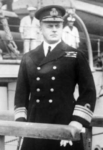
Admiral Sir Hedworth Meux, who unveiled Scott’s statue last month, was appointed Admiral of the Fleet, succeeding Sir William May. The Admiral of the Fleet is the most senior naval rank, while the First Sea Lord (John (‘Jackie’) Fisher, former Admiral of the Fleet) is the most senior professional naval role. The First Lord of the Admiralty (Winston Churchill) is the most senior political naval role.
Monday 8th March
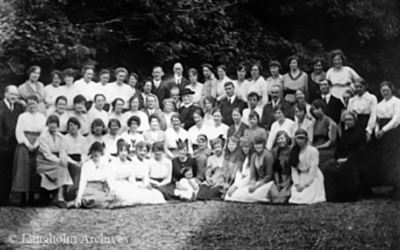
Miss Marie Danvers Smith and her No. 1 Company of Dramatic Artistes are putting on a different play each night for six nights this week in the Buccleuch Hall. The troupe has returned after a successful visit last year.
Organist Charles Metcalfe and his choir gave a recital of various songs about war and peace in the Parish Church.
Wednesday 10th March
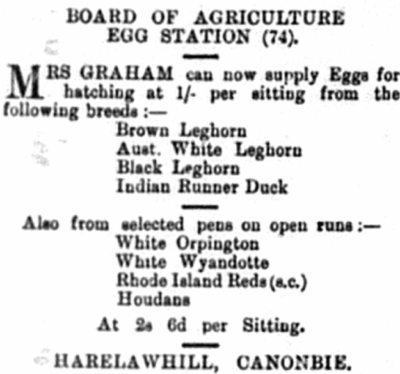
There were four adverts in the E&L today for hens’ eggs for hatching, including two by Board of Agriculture Egg Stations. The UK is a major egg importer and the war has caused much concern about supplies, prompting a need for more local production.
Thursday 11th March
Private James Thomson, a former telephone linesman whose mother lives in Drove Road, was killed in the Battle of Neuve Chapelle, aged 39. He joined the Black Watch in 1896 at age 20 and fought in the Second Boer War (1899-1902), re-enlisting in 1914 and deploying to France two months ago.
The Town Council discussed a report about the costs of improving the town’s roads and referred it to the Roads and Bridges Committee. It included statistics of High Street users over the course of a week in June 1914:
| Type | Number |
|---|---|
| Ordinary cycles | 1,512 |
| Motor cycles | 524 |
| Motor cars | 531 |
| Motor omnibuses | 1 |
| Motor lorries (rubber tyred) | 14 |
| Motor lorries (steel tyred) | 12 |
| Traction engines (trailers) | 15 |
| Light vehicles (one horse) | 432 |
| Heavy vehicles (one horse) | 869 |
| Heavy vehicles (two horses) | 18 |
| Omnibuses (two or more horses) | 10 |
| Horses (led or ridden) | 38 |
| Barrows | 387 |
| Herds of cattle | 18 |
| Flocks of sheep | 3 |
After the council meeting, Provost Easton accused four council members (Montgomery, Scott, Laidlaw and Irving Bell) of meeting in Montgomery’s hairdressing shop three years ago to determine a town council vote in advance. His informant was a council member who was now away on national duty (seemingly Major Edward Bell). All four denied pre-arranging any votes.
Saturday 13th March
John Maxwell (31) of Crown Cottage in Drove Road, a private with the Highland Light Infantry, was shot through the mouth today in the trenches near La Bassée, France. He survived and is being evacuated. Earlier, he was buried by an explosion but was dug out. On another occasion he was saved from bomb blasts by dead bodies lying on top of him. He has previously served in India. His father Thomas is a mill worker.
At the AGM of the Langholm branch of the South of Scotland Woollen Trades Approved Society (a ‘friendly society‘), it was reported that there are currently 633 members (292 men and 341 women). There were 140 sickness and disability payments and 15 maternity payments during the year.
Monday 15th March
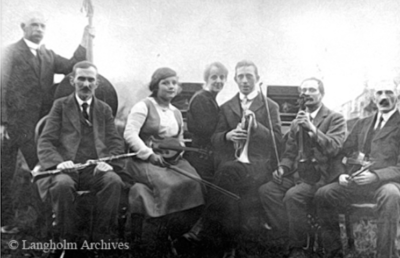
Joseph Allison, violinist and woollen pattern weaver, gave a lecture on the German composer Handel to the Townhead Literary Society in the North UF Church, accompanied by various Handel compositions performed by choir members from Langholm churches. John Milne Home, presiding, said that some might feel that this is not the time to be listening to music from Germany, but despite its current government’s policies, much is owed to German individuals in the fields of music, art, science and theology.
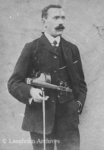
Joe has a band that plays at various local functions.
Lord Kitchener made a speech in the House of Lords saying that large orders of munitions had not been completed in time due to worker slackness and alcohol. He appealed for increased output with the promise of a medal in the event of a successful conclusion to the war.
Tuesday 16th March
Lawson Cairns is now five miles behind the front line and is on water cart duty.
A Chalmers United Free Church ladies’ working party put on a concert in exchange for a recent fundraiser for soldiers’ comforts. The hall was full and many people could not gain access. Rev David Inglis presided over two hours of Scottish and Irish songs, preceded by the Belgian national anthem.
Wednesday 17th March
The Chalmers Church concert was repeated due to popular demand.
The Langholm Town Band, the oldest continuing brass band in Scotland, issued its annual report, indicating that it currently has 20 playing members, less than normal because of military service. Attendance at practices is good, considering how much overtime members are doing at the mills.

Thursday 18th March
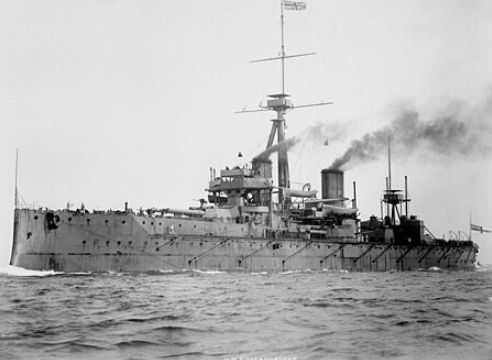
HMS Dreadnought sank submarine U-29 by ramming it in the Pentland Firth, north of the Scottish mainland.
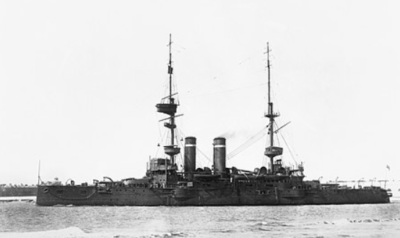
Two British battleships, HMS Irresistible and HMS Ocean, sank after hitting drifting mines in the Dardanelles.
Friday 19th March
Lawson Cairns is now on nightly trench-digging duty near Ypres, sharing a tent with two sanitary policemen and a soldier with dysentery. His shift last night began at 10.40 pm. From today’s diary entry:
Left trenches at 4.20 a.m. & got back at 6.00 a.m. The distance is about 5 miles each way over awful roads. Sleep all day except when we are disturbed for meals & even then only sit up to eat them. We were called at 6.00 p.m. & told we had to be ready in 1/2 hour. We went back to same trenches and continued digging. Each man had to carry something such as shovels or sandbags, barbed wire, a big coil of plain wire between two. We were about 200 yards from the firing line & were under pretty heavy fire all the time but only got one man wounded in the hand & leg.
Monday 22nd March
Having trained in medicine at Edinburgh University, Lawson Cairns was transferred today to medical duties in the Royal Army Medical Corps under Captain John Bowie from Edinburgh.
John Telford, a well-known blacksmith and engineer in Langholm, died, age 70. He arrived from the neigbouring parish of Canonbie 30 years ago and built up a business with his brother James, a joiner. They supplied coaches to the Eskdale Temperance Hotel for its popular local tours.
Tuesday 23rd March
The International Bible Students’ Association* is conducting a five-night ‘Photo Drama of Creation’ programme in the Buccleuch Hall this week, featuring a series of audio-visual presentations.
* A precursor to the Jehovah’s Witnesses.
Wednesday 24th March
The E&L published an appeal by the Board of Trade for women to register at Labour Exchanges to help reduce shortages in the workforce.
An adder was killed in the neighbouring Tarras Valley this week, exceptionally early in the season.

Thursday 25th March
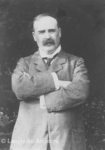
A memorial to the town’s former medical practitioner Dr John Gill was erected this week in Langholm cemetery. He died from a stroke while attending patients at Thomas Hope Hospital in April 1914. The inscription includes: ‘For 34 years a medical practitioner at Langholm. Erected by the people of Langholm and neighbourhood in grateful remembrance of a life of self-denying devotion to duty.’
Saturday 27th March
All discounted railway fares (weekend, half-day, short and long date excursions) have been cancelled until further notice, as well as special trains for Easter, due to wartime constraints.
Sunday 28th March
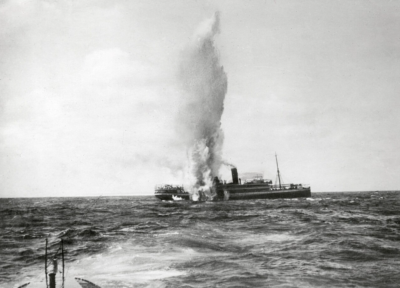
SS Falaba was torpedoed and sunk in St George’s Channel (between Wales and Ireland), killing over 100 of about 250 people on board, heading from Liverpool to West Africa. The survivors included Rev David Inglis‘ brother-in-law William Bishop, a civil engineer. A US citizen, Leon Thrasher, died in the incident, causing diplomatic tensions between the USA and Germany.
Monday 29th March
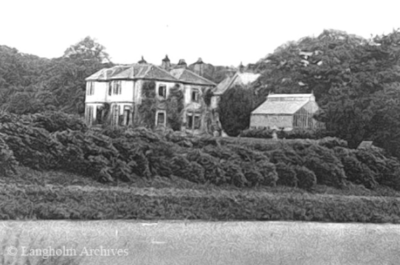
John Milne Home’s wife Mary gave birth to a son David at Irvine House, just south of Langholm. Mary (nee Mary Elliot-Murray-Kynynmound) is a cousin of Eileen Elliot who married Lord Francis Scott last month.
Tuesday 30th March
The Duke of Buccleuch’s 51st birthday is being celebrated as a holiday on his estates.
Wednesday 31st March
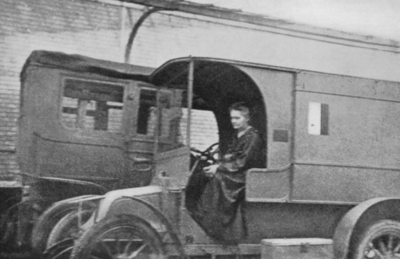
The E&L praised the work of Polish-French scientist Marie Curie, discoverer of radium which is used in X-rays. She has installed one of her radiographs in a speedy vehicle and accompanies it along the front line to help surgeons locate bullets and shrapnel in wounded soldiers.
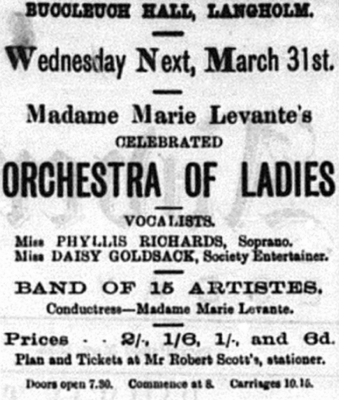
Madame Marie Levante’s internationally known Orchestra of Ladies gave a performance at the Buccleuch Hall with 15 artistes including soloist Daisy Goldsack, a popular drawing room entertainer in high society.
The E&L notes that a national daily paper has protested against the term ‘Tommy’ for soldiers (and by extension ‘Jack’ for sailors), saying that it is demeaning to the professionals and businessmen who have joined the current conflict. Its origin is in the use of the name ‘Tommy Atkins’ as a generic reference to the ordinary soldier.