The Evangelical Union (‘EU’) was formed in 1843 by James Morison with a doctrinal stance which held that people had more free will in relation to Christian salvation than described by Calvinism. This was controversial for some, since Calvinism was a highly influential worldview in post-Reformation Scotland.
An Evangelical Union congregation was formed in Langholm nearly 20 years later, in 1862. A leading participant and financial supporter was Walter Scott of Holmfoot house who owned a tannery and provided the church’s first meeting room in his bark-house in Buccleuch Square (a storage area for tree bark used in the tanning process). The church marked 1864 as its official date of foundation.
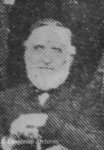
After outgrowing the bark-house, the congregation met in the hall of the Eskdale Temperance Hotel before constructing its own building on the corner of Drove Road and Kirk Wynd, designed by local architect James Burnet. Much of the funding came from Walter Scott, who laid the foundation stone. The new church was opened in 1870 by James Morison, the EU leader.
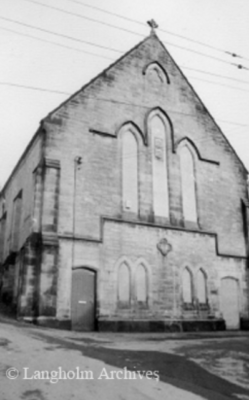
The Evangelical Union denomination joined the Congregational Union of Scotland in 1896, after which the Langholm congregation became known as the EU Congregational Church. Its combined traditions resulted in emphases on mission and temperance.
In 1914 the church celebrated the jubilee (50th year) of its foundation. Office-bearers that year were:
- Elders
- William Tweddle, Glentarras
- John Kerr, Henry Street
- Charles Paisley, The Holm
- William Douglas, Eskdale Temperance Hotel
- Deacons
- John J. Morrison, Caroline Street
- James Jardine, High Street
- William Irving, Caroline Street
- Christopher Elliot, Sorbie Cottage
- Treasurer: William Tweddle
- Secretary: Christopher Elliot
Up to 1914 its ministers had been:
- James Cron, 1864-1865
- James Campbell, 1866-1874
- Robert Borland, 1874-1877
- W. Richmond Scott, 1878-1887
- Andrew Ritchie, 1888-1894
- George McKendrick, 1894-1900
- Robert MacQueen, 1900-1913
- Richard Smith, 1913 (minister elect)
Robert MacQueen left in early 1913 to lead a church in Wallace Street, Ayr. Rev J Frederic Sanders from Pollokshiels Parish Church in Glasgow was elected to replace him but ended up relocating to Sydney.
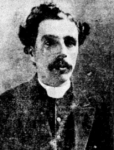
Richard Smith started preaching at the church in early 1914 while a theological student in Glasgow and became the church pastor in mid-1914. He was officially inaugurated in 1916 after completion of his studies. He was previously an ironmonger in Orkney.
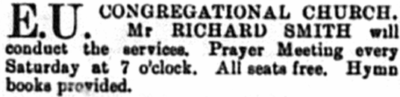
In the public sphere, the EU Congregational church was primarily involved in temperance activities, such as chairing a demonstration by the Scottish Temperance League in Market Place (see 23rd August in the Diary).
Richard Smith served for two years before being assigned to lead a new Congregational church in King’s Road, Rosyth, Fife. He had no immediate successor, with sermons being delivered by various visiting preachers.
The church celebrated the centenary of its new building in 1970 but closed the year afterwards.
< All Saints Episcopal … Events >