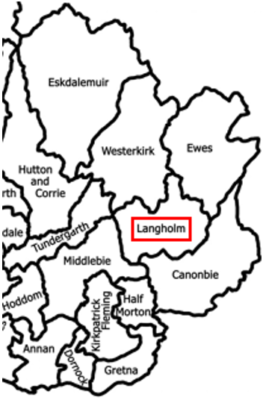
Langholm‘s Old Town grew out of a settlement dating back to the 1400s. Its New Town was developed by major landowner Henry Scott, 3rd Duke of Buccleuch, in the late 1700s. They are separated by the River Esk which flows south to the Solway Firth near Carlisle.
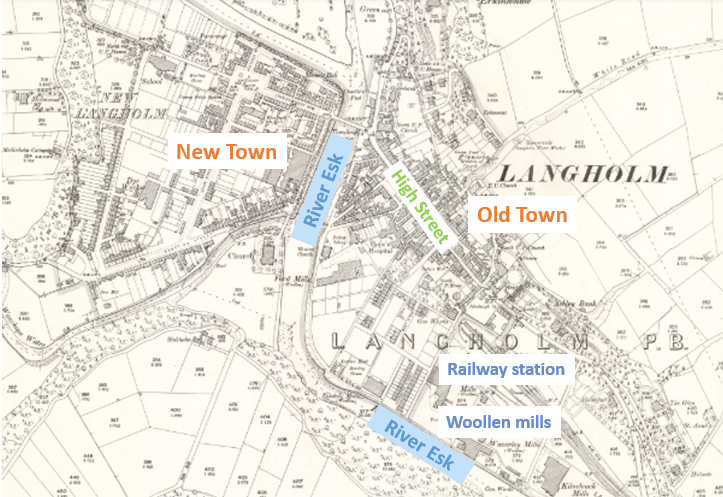
In 1915, Langholm parish had:
- A population of around 3,300.
- Five woollen mills.
- Six hotels and an entertainment hall.
- A distillery, tannery and sawmill.
- A thriving High Street.
- 15 farms.
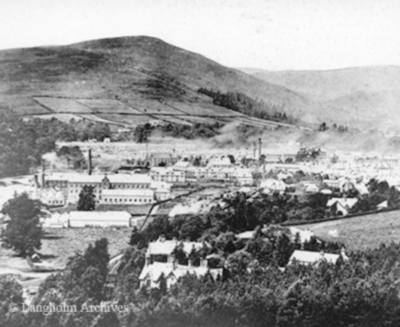
Some mill buildings and chimneys can be seen on the left in the photo below. The railway line ran from a junction on the Edinburgh-Carlisle line into a terminus near the centre of the photo. The houses in the trees in the foreground belonged to business owners.
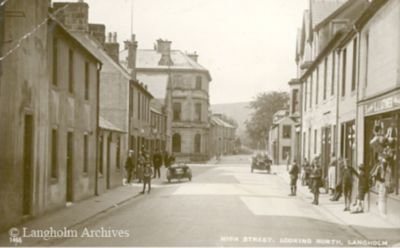
The colorised photo below shows the north section of the High Street. The town hall is in the distance with its clock tower.
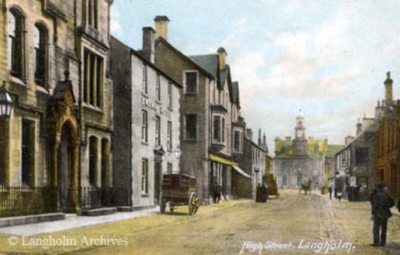
The following photo is also of the north section of the High Street, looking in the opposite direction.
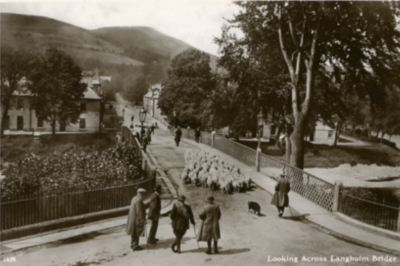
Langholm Bridge over the River Esk was constructed in the 1770s. One of the masons was Thomas Telford (1757-1834) who grew up in the neighbouring parish of Westerkirk and went on to design numerous infrastructure projects. In later life he made significant donations to the Langholm Library and the Westerkirk Parish Library.
Langholm parish was in east Dumfriesshire, which was amalgamated in 1975 with Kirkcudbrightshire and Wigtownshire to form the Dumfries and Galloway region, now the Dumfries and Galloway council area.