The temperance movement began in the 1830s in the UK and soon there were many ‘temperance hotels’ across the country, providing the usual hotel facilities but not serving alcohol.
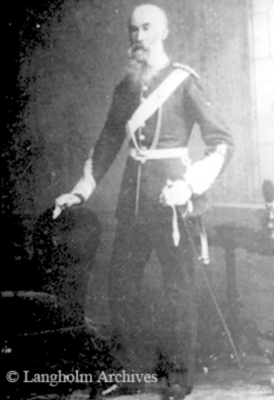
William Douglas* (1855-1917), keeper of the Eskdale Temperance Hotel, bought it in around 1887 and ran it until his death in 1917. He had previously operated a restaurant in Glasgow and was married first to Isabella Ross (1835-1904) from Rossshire. Two years later, when 51, he married Mary Paterson (1882-1907) of Sanquhar, Dumfriesshire, aged 23, who died the following year. He was married a third time, to Eliza Little of Selkirk in 1909.
* Not a close relation to Robert Douglas, innkeeper of the Shoulder of Mutton inn which later became the Douglas Hotel.
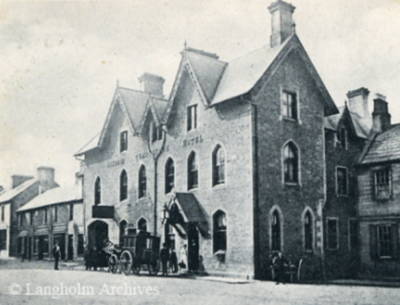
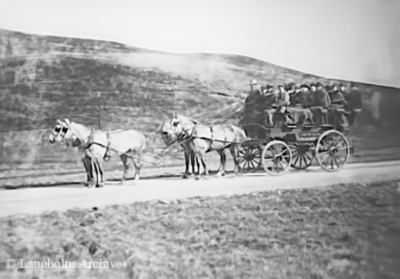
He was joined in Langholm by his brother Robert (1858-1942), a coachman, and together they ran Eskdale and Liddesdale Coach Tours, with daily departures from the hotel.
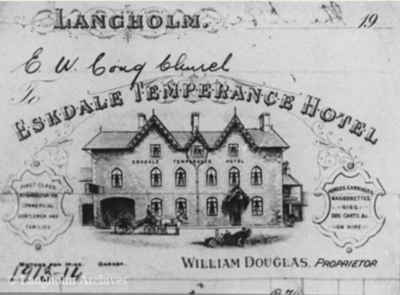
Many businesses at the time issued elaborate ‘billheads’ as proof of payment or goods/service delivery to customers, such as the one below from the Eskdale Temperance Hotel issued to ‘E U Cong Church’ (the Evangelical Union Congregational Church).
The Eskdale Temperance Hotel came into being in 1865-1867 when Colonel William Malcolm (1817-1907) of the Burnfoot estate near Langholm bought the King’s Arms inn in Langholm and rebuilt it, incorporating reading rooms for working men as a distraction from alcohol. Its hall was a popular place for large meetings and entertainment such as dances and carpet bowls.
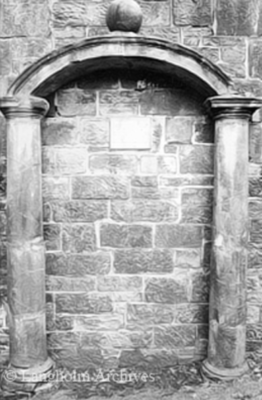
The arch below, designed by Thomas Telford (1757-1834) while a mason’s apprentice, is said to have been a doorway in the King’s Arms. It is now located near the Eskdale Hotel (no longer a ‘temperance’ hotel).
A King’s Arms innkeeper in the 1850s was widower Thomas Walker (1790-1861). He had been married to Janet Hope (1803-1852) who was tried in 1845 for the murder of her 12-year old son George by arsenic when she and Thomas were innkeepers of the Blue Bell Hotel in nearby Lockerbie.
The key witness was the keeper of Dumfries prison John Kidd who gained her confidence as a spiritual confidant while she was being held before trial, and claimed in court that she had indirectly made incriminating admissions. This testimony was ruled to be inadmissible because of the way in which it was obtained. The prosecution abandoned its case, despite having a witness claiming to have sourced arsenic for the ‘pannel’* (the accused), resulting in a verdict of ‘assoilzied simpliciter‘* (not guilty).
* Historic Scottish legal terms. ‘Assoilzied’, pronounced ‘as-SOIL-eed’, means that the court has found in favour of the defender of an action (the term ‘defendant’ is not used). Simpliciter means ‘absolutely’. See here for a glossary of current Scottish legal terms.
< Douglas Hotel … Buccleuch Hall >