Glentarras Distillery (sometimes Glen Tarras) was built in 1839 for James Kennedy, formerly a partner at Langholm Distillery, and produced up to 75,000 gallons of whisky per year, a ‘highly and richly flavoured Malt‘, sold mainly in London.
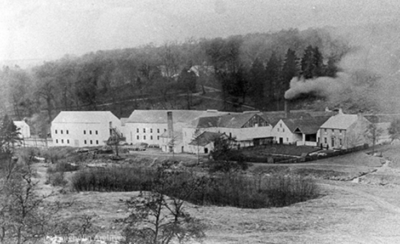
It was purchased in about 1903 by London-based gin manufacturer, Seager Evans and Co., seeking to diversify into whisky but this was unsuccessful and the distillery stopped operating in 1905.
The site was still owned by Seager Evans in 1915 and had a manager, a widow and two labourers living on site. The manager Thomas Welburn was usually described as an excise or Inland Revenue officer, for example in an E&L report in December 1915 about Langholm’s freemasons’ Lodge Eskdale Kilwinning of which he was a former Right Worshipful Master. The report also described him as a member of Lodge Hubli, Bombay, India, probably in connection with two of his sons being based in India.
In 1916 the distillery was converted into a large hostel for workers at the Gretna munitions factory, many coming from Ireland. Additional rail services were added to assist the hostel workers’ and others’ commutes between Langholm and Gretna.
In September 1916, three munitions workers were returning to the hostel from town at about 9.30 pm, very drunk. Two of them threw the other over a wall onto the bank of the River Esk, near Skipper’s Bridge, and jumped down to join him. After an argument, they threw him into the river and he disappeared.
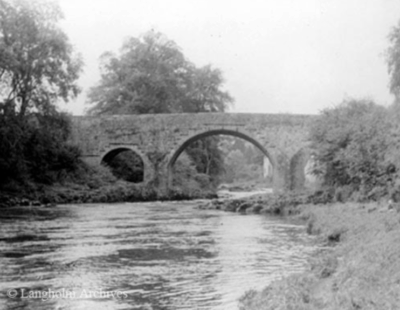
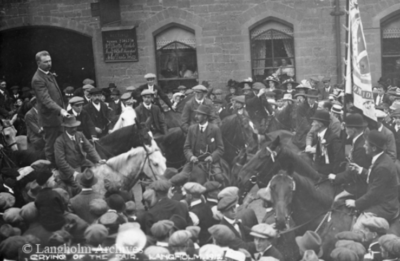
Christopher ‘Kirst’ Elliot, fair crier at the Common Riding, was fishing nearby with John Corrie, a mill worker. Corrie fetched the police who started a search, soon abandoned because of darkness but it was resumed the next morning. The body of Lawrence Niven (37) was found underwater. He had a letter in his pocket from his wife, asking for money, and was from Glasgow, with five children.
James Stevenson (47) from Glasgow and John McGrory (29) from Dublin were arrested and tried for murder in Dumfries in November 2016. After evidence from Elliot and Corrie, the accused men’s lawyer changed their plea from ‘not guilty’ to ‘guilty of culpable homicide’, for which they were convicted. Stevenson and McGrory were sentenced to 18 and 12 months’ imprisonment respectively.
The main buildings were demolished in 1926 with some of the smaller ones being retained as residences. One of the long-term occupants was coal agent and community leader Clement Armstrong who married Thomas Welburn’s daughter Ruby in September 1915 and subsequently lived at Glentarras until his death in 1943.
< Langholm Distillery … Tannery >