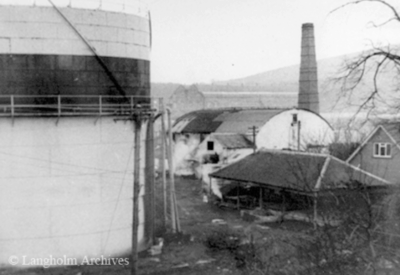
‘Town gas’ (i.e. manufactured, unlike ‘natural gas’) was made by heating coal in the absence of oxygen, producing a flammable and poisonous mix of carbon monoxide and hydrogen. It was replaced with natural North Sea gas in the 1970s.
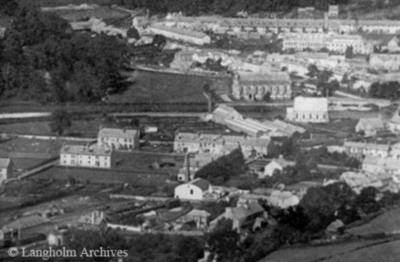
The Langholm Gas Company was formed in 1836, constructing a gasworks in the Old Town near the major woollen mills. It included the white-fronted building in the lower centre of the photo below.
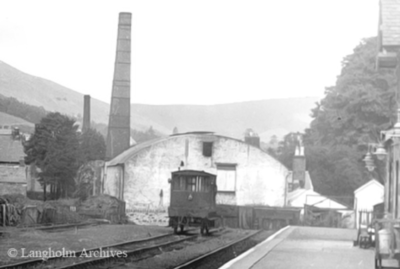
The gasworks was next to the railway station after the latter’s construction in 1864.
Gas and electrical fires at the mills could cause considerable damage and there were also periodic incidents in shops and houses, such as the gas explosion in Charles White’s jewellery shop in 1901. It stunned him, burnt his eyebrows and singed his clothes.
The gasworks manager in 1915 was Andrew McNair (1878-1941) from Lanarkshire, whose father James had also been a gasworks manager. He lived in a company property at 19 High Street.
The company secretary was John Fairley (1853-1930), a bank accountant. His two sons Mungo and Archibald died in the war in 1916, Mungo with the Border Regiment and Archibald with the Canadian Corps.
George Armstrong (1862-1939) of 3 West Street was a gas stoker who loaded coal into heated chambers (‘retorts’) and unloaded the resultant residue: coke or powder, depending on the coal type*.
* ‘Metallurgical’ coal produces clumps of coke, whereas ‘thermal’/’steam’ coal results in a powder. Local Canonbie coal was primarily metallurgical. Coke is a vital component for steelmaking blast furnace operations, usually making metallurgical coal more valuable than thermal coal.
A former manager was James Paterson (1857-1911), who bought 3, 5, 7 and 11 Gas Entry, which was the road off the High Street to the gasworks. He used to live in number 11. In 1915 the properties were owned by his trustees, with non-gasworks tenants.
The ‘gasometer’ (or ‘gas holder’) below was constructed in 1932 and demolished in 1982.