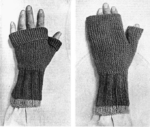
The main product was woollen cloth for conversion into finished products elsewhere. During the war, the main contracts were for cloth for military uniforms. In peacetime, the town was known for its various types of tweed. There was also a hosiery sector, producing knitted items.
1. Uniforms
Military uniforms were typically made from wool rather than cotton, for durability, warmth and flame resistance.
The two main types of cloth for uniforms were khaki for British forces and blue-grey for French.
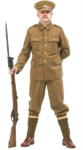
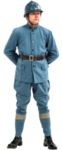
Khaki was introduced as the standard British uniform during the Second Boer War, replacing red coats, to blend in better with the South African landscape.
At first there was not enough khaki available for the large surge in recruits in 1914 and 1915, so some alternative uniforms were used temporarily, including half a million post office suits.
Part of the challenge was a severe shortage of dyes, including khaki, as much of the supply came from Germany, and it took some time for replacement sources to be generated.
2. Tweed
Tweed is traditionally a closely-woven wool fabric which is relatively heavy and often brown or green in colour. It was associated with British aristocratic outdoor leisure pursuits and became popular among the middle classes in the early 1900s.
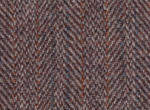
The term is sometimes said to be derived from a misinterpretation of the word ‘tweel’, Scottish for ‘twill’, a type of textile weave. Legend has it that it was wrongly assumed to be a brand name associated with the River Tweed and that the name stuck.
The wool is dyed before carding (straightening) and the mixed colour effects are usually achieved by combining differently coloured batches before spinning (see Woollen manufacturing process).
Designs can be highly intricate and the role of ‘tweed designer’ was a prestigious one in the industry.
Non-traditional ‘fantasy tweed’ can incorporate non-wool materials such as silk and artificial fibres and is often in brighter colours.
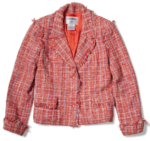
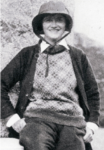
Coco Chanel did much to popularise both traditional and fantasy tweed in the 1920s. She became familiar with British aristocratic clothing through her 10-year relationship with Hugh Grosvenor, 2nd Duke of Westminster, staying regularly at his Scottish estates in Argyll. Below she is wearing a tweed jacket in the Scottish Highlands.
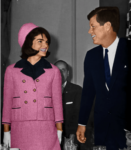
Initially she sourced much of her supply from Linton Tweeds of Carlisle but demand became so great that she set up her own manufacturing facility outside Paris. One of her iconic tweed designs was a pink suit worn by Jackie Kennedy.
3. Hosiery
The term ‘hosiery’ in the woollen industry in the 1910s referred to a variety of knitted products, including headwear. It became more associated with women’s stockings after the invention of nylon by Du Pont in 1935.
Although knitting machines were used to some extent, much of the output was by hand. Hosiery was produced commercially before and during the war, but high demand for ‘soldiers’ comforts’ also led to substantial provision by volunteers (see Town support).