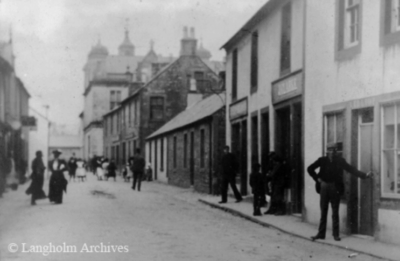
93 High Street
Alexander Montgomery (1867-1934) was from Edinburgh, then Glasgow, and has been on the Town Council for several years. He became its junior bailie (magistrate) in November 1914 after two others declined to be nominated. However, he resigned in April 1915 after being accused of vote-rigging in his hairdresser’s shop by provost Thomas Easton (see below).
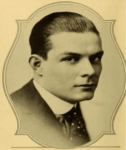
Men’s hair was often combed back using oil, but side partings and artificial waves are also popular. Frenchman Marcel Grateau (1852-1936) patented curling irons in the USA in 1905, producing tight S-shaped ‘marcelled’ waves. Another style is the lighter waved ‘pompadour’, with more height.
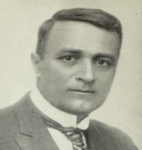
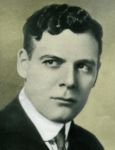
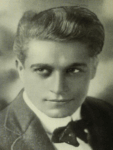
There were a number of moustache styles in vogue, but the general trend was towards a more clean-shaven look.
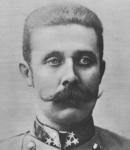
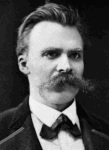
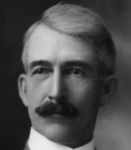
Soldiers were forbidden from shaving their upper lip, as mandated by the King’s Regulations of 1860, although moustaches generally became narrower to assist the use of gas masks in the trenches. The Regulations were amended in 1916 to remove the prohibition.
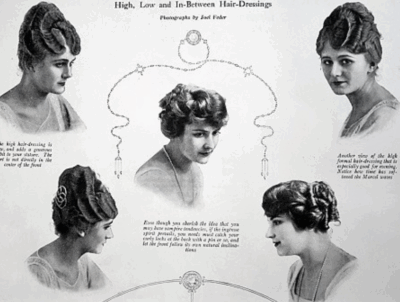
Women’s hairstyles became less elaborate during wartime, partly for thrift and also because of workplace practicalities. Nevertheless, many formal styles still had a high shape, often including marcelled waves. Some women continued to use formal hairstyles as a statement that the UK would not change its lifestyle due to enemy pressure.
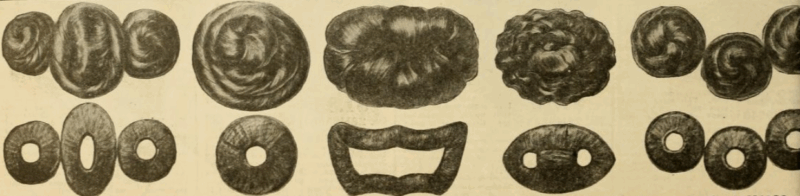
Hairpiece additions, known as ‘switches’, were used to provide bulk and decoration, in the shape of ‘knots’, ‘coils’ and ‘twists’. These could be matched for colour by providing a sample of one’s own hair to mail order magazines, which are particularly popular in the USA.
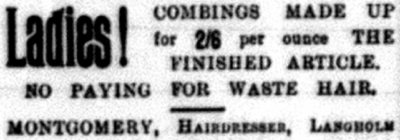
In addition to supply by mail order, switches could also be ‘made up’ by local hairdressers such as Alexander Montgomery by using ladies’ own ‘combings’ (collected loose hair).
A recent innovation in ladies’ shorter hairstyles was the ‘bob‘, invented in Paris in 1909 by Polish Antoni Cierplikowski, one of the first celebrity hairdressers, known as ‘Antoine de Paris’ and ‘Monsieur Antoine’.
Another reason for its popularity was American actress and dancer Irene Castle keeping her hair short after cutting it for an appendectomy in 1914.
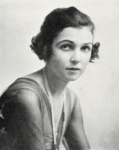
The ‘bob’ continued its popularity into the 1920s, adopted by Cierplikowski’s clients such as Coco Chanel. It has had repeated incarnations since then.
The Town Council vote-rigging controversy went as follows (see March and April in the Diary):
- After the council meeting, Provost Easton accused three council members (Montgomery, Scott and Laidlaw) and the town clerk (Irving Bell) of meeting in Montgomery’s hairdressing shop three years ago to determine a town council vote in advance. His informant was a council member who was now away on national duty (seemingly Major Edward Bell). All four denied pre-arranging any votes.
- Alex Montgomery handed in his letter of resignation to the town clerk George Irving Bell prior to the next town meeting.
- At the end of the meeting, he let loose a tirade, declaring that Provost Easton had gone on the principle of ‘if you haven’t any argument against a proposal, abuse the proposers’ […] Seemingly in all things we should think as he thinks. Such is an insult to the intelligence. It is too much like “Kaiseritus”. […] For three years he has “nursed his wrath to keep it warm”. […] Apparently any member of Council who patronises my business is under suspicion. […] Apparently Provost Easton still thinks he is right for there has been no withdrawal of the statement which would have been only gentlemanly. I think I have proved he is wrong.’
- Montgomery then bade good-bye to the town council and left the room.
Alexander’s wife Maggie Clark (1878-1915) died in December 1915, shortly after the birth of their sixth child. Their three sons are too young to be of military age. Their second daughter Maggie was awarded a Hannahfield Bursary in 1915 for academic achievement (see Education).
Alexander was a Junior Deacon (a mentoring role) at the local freemason’s lodge. He remarried in 1920 and lived in Glasgow from the mid-1920s.