Market Place
Katherine Ritchie (1849-1916) ran the business with her son Wemyss (1876-1956) after her husband died in 1899. Wemyss moved to Montrose, Angus, in 1908 and they went to court against each other in 1909 over a sum of £450 (£40,500 today).

The Pharmaceutical Society of Great Britain maintained a register of chemists and druggists, and only those on the register could describe themselves as such. ‘Chemists’ usually had a higher level of training than ‘druggists’, although the terms were sometimes used interchangeably or in combination.
Sales by chemists, druggists and drug stores were largely unregulated, with only specified poisonous substances being strictly controlled. Some chains of drug stores had been established by 1915, such as Boots, developed by Jesse Boot (1850-1931) with over 550 branches, but most were local family businesses.
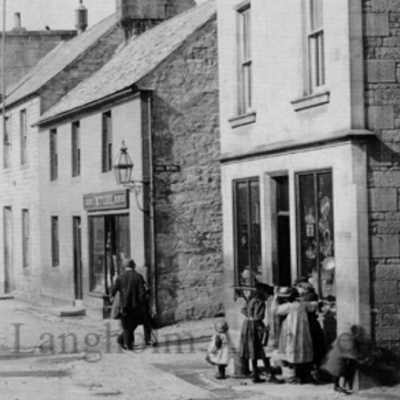
Although the peak period of ‘quack’ medicines was in the 1800s, they were still widely promoted in the 1910s. The term is derived from an old Dutch word, quacksalver (‘hawker of salves’), denoting unproven claims, often about a wide range of cures by the same medicine (a ‘cure-all’).
Budden’s S.R. Skin Ointment may have been a quack medicine, available from Ritchie’s:
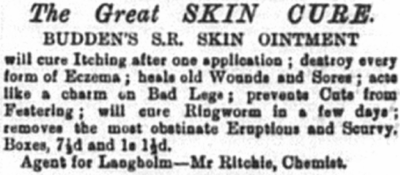
Ritchie’s also sold Budden’s Balsam of Horehound and Coltsfoot (herbs) for coughs, colds, asthma, bronchitis and ‘all affections of the chest and lungs’.
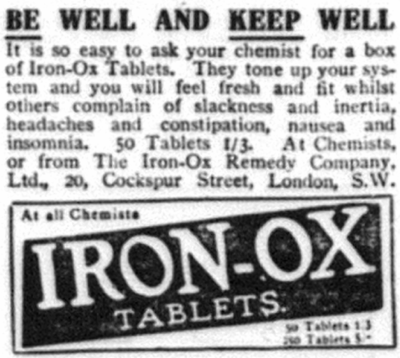
Another product from chemists, promoted in the local paper, was Iron-Ox, with claims similar to those for Tonic Quinine Wine sold by Grocer – J B Balfour (Walter Glendinning).
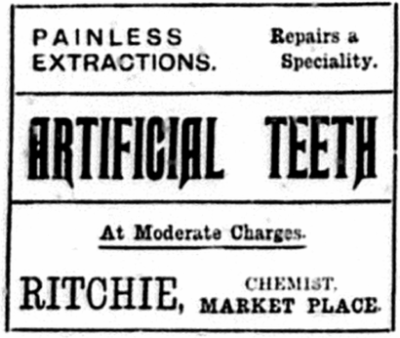
The Ritchies also used to provide a dental service, but this has been discontinued (see ‘Dentist’ here).
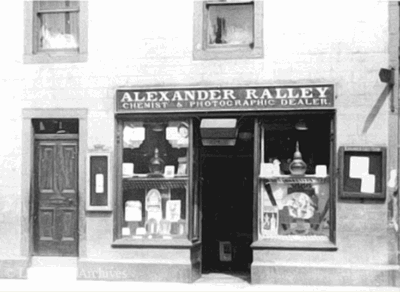
Katherine died on a visit to the holiday resort of Silloth, Cumbria, in 1916, and the business was sold to Alexander Ralley from Midlothian:

Alexander Ralley was also a photographic dealer.
Wemyss became provost (mayor) of Montrose, Angus, from 1943 to 1946.