50 High Street
1915
Wristwatches are almost exclusively for women, whereas men use pocket watches. The main exception is in battle, when it is often impractical to keep removing a watch from a pocket.
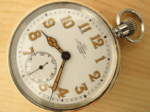
Many army officers are wearing wristwatches in the current war, which have to be very sturdy to avoid being broken in trench combat.
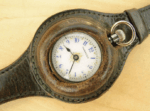
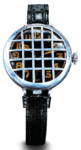
Some are protected by a metal mesh or a leather cover.
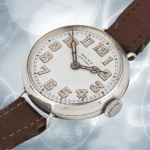
Luminous paint, made from radium and zinc sulphide, is put on dials and watch hands to make them visible in darkness.
Two of the main watch manufacturers in the UK are Rolex and the Dennison Watch Case Company. Rolex is based in London and imports watch mechanisms (‘movements’) from Switzerland, sealing them in metal and glass cases, together with their own branded watch faces. Dennison is based in Birmingham and produces cases rather than movements.
Watchmaking retailers like Joe Anderson (1853-1918) usually assemble parts obtained from suppliers rather than doing their own machining. In the photo below, Joe’s premises are on the right, just after Walter Wilson’s shop which has two people standing outside.
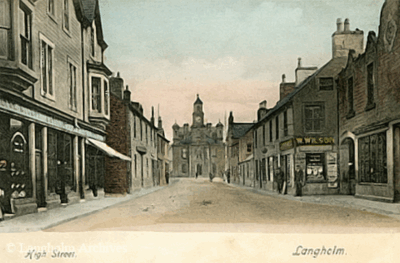
Joe is also a jeweller, optician, fishing tackle retailer and an agent for an umbrella and sunshade repair company. He is originally from Leith, Midlothian.
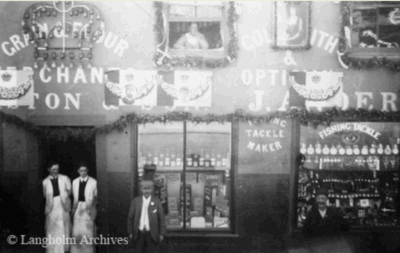
He is an enthusiastic freemason and lawn bowls player, sometimes combining the two interests in masonic bowling competitions (note the aprons in the photo below).

Joe’s elder son Drummond (1886-1947) has followed his father into the watchmaking business and is with the Motor Transport section of the Army Service Corps.
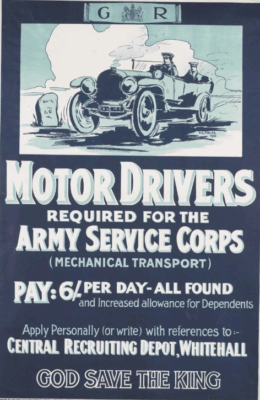
Joe’s younger son Arnold (1887-1965) is adopted, the son of Jessie Galloway, a solicitor’s daughter in Edinburgh. He has emigrated to Queensland, Australia, where he is a farmer, but has returned to join the Gordon Highlanders, whose motto is ‘Bydand’, a Scots word meaning ‘steadfast’.

Joe’s daughter Myrtle is married to John Halliday, a Duke of Buccleuch gamekeeper.
Joe is mentioned five times in Lawson Cairns‘s 1915 war diary, written near the Western Front:
1st August: Recd. parcel from Galashiels also watch back from Joe Anderson.
26th August: Received letter from Aunt Marie & watch holder from Joe Anderson.
27th August: Wrote letter to Joe Anderson & Aunt Marie.
11th October: Received parcel from Uncle T., H & C Wilson, Gala & Langholm Soldiers Committee & letter from Joe Anderson.
16th October: Wrote to Mrs Marks & Joe Anderson.
Post-1915
Joe’s son-in-law John Halliday was killed on 28 November 1917 while with the 16th Highland Light Infantry in Flanders. He and Myrtle had three sons.
Drummond was taken prisoner during the war but returned home prior to his father’s funeral. Joe died at the end of December 1918, aged 65. The obituary in the local paper said:
Of a cheery and bright nature, he gathered round him many friends who were wont to make his shop a daily rendezvous, and hear ‘Joe’s’ version of events and things of the moment.
E&L, 1 Jan 1919
More and more soldiers, whether officers or other ranks, started wearing wristwatches as the war went on. They continued to wear them after the war, and the wristwatch was soon a desirable item for much of the male population.
Luminous radium paint was not understood to be poisonous until the 1920s, discovered mainly through the illness of many women who painted watches and clocks.
Rolex relocated to Switzerland in 1919 after the introduction of high import and export taxes in the UK.
< Stationer … Hospitality >