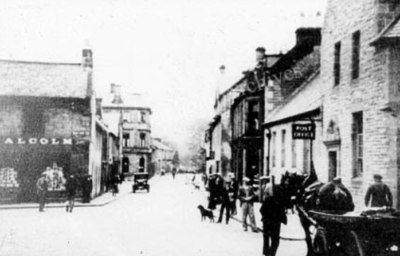
The Langholm area’s main post office was at 34 High Street, between the car on the left and the three-storey building in the distance:
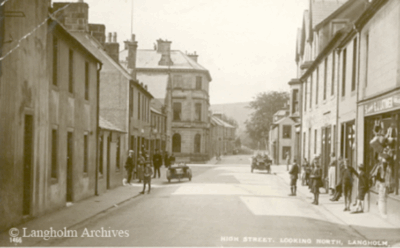
It had six sub-offices, one of which was on the ground floor of the Langholm Library building, with an entrance from the High Street. Other sub-offices were in nearby parishes.
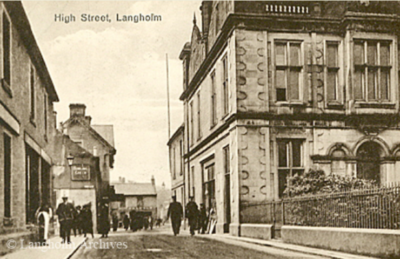
The main post office opening hours were 8 am to 8 pm on Mondays to Saturday and 9-10 am on Sundays.
Collections from the main postbox were as shown below for Monday to Saturday, in addition to collections from other postboxes in the area. The last Sunday collection was at 4.40 pm.
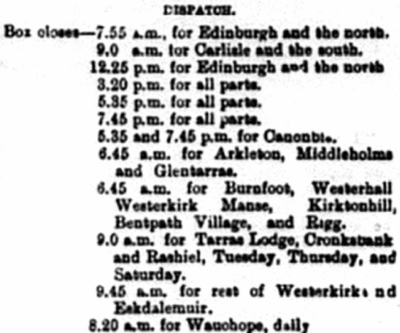
Local deliveries commenced at 7 am, 10 am and 6 pm from Monday to Saturday, and at 9.15 am on Sundays.
The postal service between Langholm and the Western Front was very well used (see Home support). In his war diary, Lawson Cairns recorded receiving parcels, letters and postcards near the Western Front around three or four times a week.
Walter Wilson, publisher of the E&L, gave guidance as to how to address correspondence to soldiers with the KOSB:
[…]
Local postal employees included:
- Postmaster
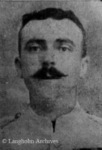
- John Rhodes (1864-1935) from Yorkshire. Langholm postmaster since 1908.
- Postal clerk
- Robert Hyslop (1880-1936) joined the Royal Garrison Artillery. He married Mary Sanders in 1906, daughter of the draper and civic leader Henry Sanders (1847-1914).
- Sorter/telegraphists
- Two male and two female.
- 13 postmen, including:
- David Hogg (1864-1945) from Canonbie, Dumfriesshire. Sunday School superintendent for the South United Free Church.
- George Main (1866-1940) from Langholm.
- William Storey (1869-1946) from Langholm. Former sergeant in the Seaforth Highlanders. Seconder of a motion to cancel the 1915 Common Riding in its entirety: see 20 May 1915 in the Diary.
- Gavin Tait (1874-1957) from Hoddom, Dumfriesshire.
- Patrick Friell (1883-1975) from Buteshire. Joined the Royal Horse Artillery as a gunner in 1901 and re-enlisted.
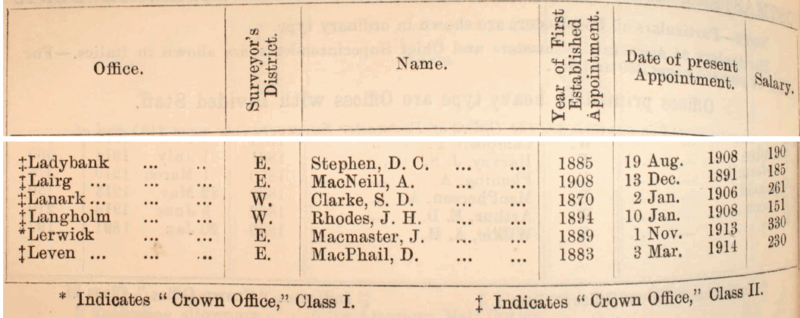
Postmaster John Rhodes’s salary was £151 per year, published in a Post Office directory (below). The postmaster in Lerwick on the Shetland Islands earned more than twice as much (£330), despite its remoteness, due to the high volume and importance of its telegraphic traffic. Lerwick was a vital naval base, designated as an ‘examination port’ to implement the naval blockade of Germany.
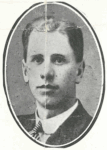
Former Langholm postal clerk George Sharp (1886-1915) was killed in the Battle of Loos in France on 25 September 1915, aged 29. He had transferred to the telegraphic department of the General Post Office in London prior to service with the London Scottish regiment.
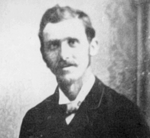
A former postman was James Grieve (1863-1911), father of Christopher Grieve, the latter subsequently known as the poet Hugh MacDiarmid. His daily route on his bicycle was through the Ewes valley. After having almost never been ill previously, he caught pneumonia and died at age 47.
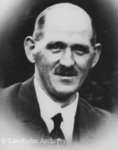
D M Black became Langholm postmaster in 1921 after John Rhodes returned to Yorkshire. A later postmaster was former Langholm postal clerk Robert Hyslop (1880-1936).
The post office moved to Market Place in 1935.
See here for information on the General Post Office.