20 High Street
Trading name: J & R Grieve
A growing shortage of ‘strong’ flour (milled from hard wheat varieties) began to to lead to the use of ‘plain’ (lower gluten), oat and rye flour to maintain bread production volumes.
Similarly, constraints on sugar supplies led to the use of alternative sweeteners, such as honey, syrup and molasses. Robert Grieve (1865-1950) advertised in 1915 to try and obtain some bees to make more of his own honey. He already had four hives but production was down because of heather blight that year.
Robert owned his deceased grandfather James’s and father Robert’s bakery business. His brothers chose alternative careers: James (1864-1896) was an editor at the E&L for 10 years but died at 32 and Thomas (1871-1945) was a bank accountant. His uncle was Walter Wilson, stationer at 50 High Street and publisher of the E&L.
In 1888, J & R Grieve installed a plant for aerated drinks, including lemonade, ginger beer, ginger ale, soda, lime juice and ‘Seltzer water’ (carbonated plain water). Another product is ‘Kola champagne‘, which is neither cola nor champagne, but instead has some similarities to cream soda or Scotland’s Irn Bru (originally Iron Brew), launched in 1901.
Carbonated water was developed in 1767 by the English polymath Joseph Priestley and commercialised by German watchmaker Jacob Schweppe, who founded the Schweppes company in Geneva in 1783.
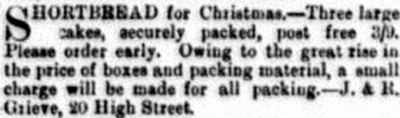
Like other bakers in the town, Robert promoted shortbread sales in the run-up to the festive season.
Robert was married to Sarah Hyslop (1864-1938) and they had two daughters, Janet and Margaret. They gave regular donations of lemonade, cakes, pies and vegetables to the Red Cross Hospital.
Other bakers in the town were John Harkness, William Herries and A & J Sharp. William Herries worked with the YMCA in France and gave a talk about its wartime role (see 13 June 1915 in the Diary). He lost a son David in France in 1917 and committed suicide in 1920.