81 High Street
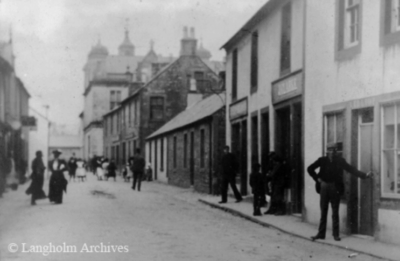
Robert Ramage (1854-1933) was born in Glasgow, the son of a bell hanger. His shop in Langholm was on the right hand side in the photo below, two premises this side of the large Library Building in the distance.
As domestic plumbing became more common, the demand for Robert Ramage’s services was mainly for new installations of indoor systems for baths, sinks and toilets.
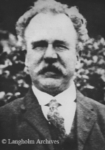
Similarly for gas, his work was mostly for new installations for lighting and cooking. Heating was still mostly by coal and wood. There was a gasworks in the town and a coal supply from Canonbie, a few miles away.
Robert was a keen participant in community activities, including:
- Lawn bowls: president, Old Town Bowling Club.
- Carpet bowls: member.
- Freemasonry: member of Langholm’s Lodge Eskdale Kilwinning No. 107.
- School Board: member.
- Common Riding: committee member.
As incoming president of the Old Town Bowling Club in 1915, he suggested that the club should adopt the practice of some other clubs of having lady members, which was implemented.
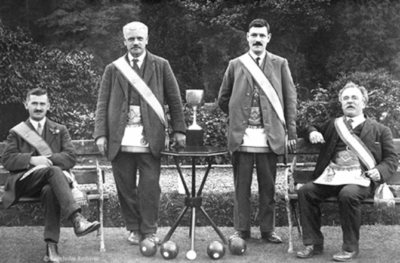
Robert combined his bowling and freemasonry interests in Dumfriesshire masonic bowling tournaments (on the right in the photo below).
He caused considerable controversy in 1915 by proposing a motion for the Common Riding to be cancelled in its entirety, which was initially adopted but later overturned (see May, June and July in the Diary).
He was criticised by opponents for his participation in other local festivities such as a large tea party at the Old Town Bowling Club, over which he he presided (13 and 26 May 1915 in the Diary). He also came under criticism for attending a wild west show that was performed in Langholm in a huge tent with a capacity of 10,000 people (8 and 16 June 1915 in the Diary).
In the midst of the controversy, his son William (1891-1915) was killed in the Dardanelles while serving as a platoon sergeant with 1st/5th KOSB, aged 24 (21 June 1915 in the Diary). His funeral there was attended by his younger brother John (1894-1976) who was also with 1st/5th KOSB. John was wounded on 13 July 1915 at the Battle of Achi Baba Nullah.
Lieutenant James McGeorge, 1st/5th KOSB, and also of Langholm, wrote:
Monday, 21st June, 1916
Dear Mr Ramage,
It is with deep regret that I have to inform you of the death of your son, Willie, at 6.30 this morning.
My platoon and another were occupying slightly advanced trenches overnight, and we were returning to our own trench by way of a communication trench in single file, when a stray piece of shrapnel hit him in the head. I was close behind him at the time. The medical officer informs me that death must have been instantaneous and painless. He was buried this morning in presence of his brother and myself and George Cowan has made and erected at his grave a cross bearing the inscription: “To the memory of Sergt. W. Ramage. 5th K.O.S.B., killed June 21. 1915. R.I.P.” The Brigade Chaplain conducted a service at the graveside. The whole Company is downcast over his death. as he was well liked by all and was without a single enemy. I consider this to be a very fine testimonial to his character, as one in his position exercising authority over men who have not been accustomed to strict discipline before mobilisation, is very apt to make one or two enemies, but I can vouch for it that this was not so in his case. Personally, I am very grieved as his loss, as through it I have lost not only an excellent platoon sergeant, but also a good friend. I am very sorry for John who is bearing up. Please convey to Mrs Ramage and family the sincere sympathy of myself and all officers and men of B Company.
Yours sincerely,
J. McGeorge, Lieut.
P.S. – The Colonel and Major Miller attended the funeral.
Major Miller wrote:
Dear Mr Ramage,
Permit me to add my expression of sorrow at the loss of your son Sergt. Ramage. He was a fine young fellow, and did his duty manfully. I grieve with my comrades at his loss, and with them join in sympathy to you and yours.
Believe me, yours sincerely,
Will. J. Miller, Major
The E&L commented:
Sergt. Ramage who was only 24 years of age, has been associated with his father in business for several years now, and throughout the town he was universally liked and respected, his genial disposition making for him very many friends. As this is the first casualty among the Langholm Territorials in the war it has naturally created a deep impression on the minds of the people of Langholm, and many expressions of sympathy have been extended to Mr and Mrs Ramage and their family in their loss.
The E&L added a pulpit reference made by Rev George Orr at the close of the morning service in the North UF Church on Sunday 11th July:
Sergeant Ramage was killed at the Dardanelles about 6 o’clock on Monday morning, the 21st of Jane. His company, having done its turn of duty in the firing line, was returning through a communication trench in single file, he leading, when a piece of shrapnel struck and killed him. As was the case with Elijah, the great change came to him as he walked. He was buried about three hours afterwards, and the gathering at the grave was composed of the Chaplain who conducted the service, the Colonel of the Regiment, Captain Clark-Kennedy, Lieut. McGeorge, together with Private John Ramage, grieving sorely for his beloved brother, and Privates George Cowan, Robert Bell, and Thomas Davidson. Sergeant Thomas Morrison and Private George Cowan, friends of the dead soldier, and skilled in the handicraft of wood, made and erected a cross, shaped with loving care, and bearing the inscription,
To the memory of Sergeant W. Ramage,
5th K.0.5.B.
Killed 21st June, 1915,
R.I.P.It melts the heart to picture these dear Laugholm lads, and especially his brother John, standing sadly round the grave of the first to fall of the Langholm Territorials.
But neither they, nor we, should sorrow over-much. The character of William Ramage is known to us all. As a congregation we saw every week, for years, his exceeding faithfulness and helpfulness in the church choir. All who had the slightest acquaintance with him knew him to be a most kindly, even tempered, four-square, well-principled, sterling man. His friends and fellow-soldiers were well aware, by experience, of his obligingness and thoughtfulness, the unselfishness and loyalty of his attachments, and that a truer comrade they never had and never can expect. So he was popular as a sergeant; his officers respected him, and his men would do anything for him. Above all, his brother writes, “His Testament and other things I will send as soon as possible. I feel confident he was prepared for the Hereafter, as, during the last fortnight, life and death have been brought nearer to us all than ever was the case before.”
E&L, 14 July 1915
Younger son John was discharged after being wounded but soon re-joined. He was later a coppersmith in London.
Robert operated the limelight for various dramatic productions and talks, including a fundraising concert for sphagnum moss dressings and a presentation on hymns by writer David Beattie.
Robert appealed to the County Military Appeal Tribunal in Dumfries in April 1917 against the call-up of his sole employee Thomas Davidson, which was rejected.
In 1918 Robert was chairman of managers at the North United Free Church.
In 1919 he was appointed to the committee of a new Langholm branch of the Scottish section of League of Nations Union. The Union supported the aims of the League of Nations, the prime one being the preservation of international peace.
After Robert’s wife Nicholas* died in 1927, he retired to Costorphine, Edinburgh, where he died in 1933, aged 79.
* A female name in some parts of Scotland until the late 1800s.
< Milliner … Post office >