42 High Street
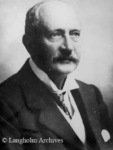
Simon Hyslop (1847-1928) was primarily an outfitter but also had a drapery section.

There were three main types of fabric retailer, although they were often combined on the same premises:
- Outfitter: finished clothes.
- Tailor/dressmaker: made-to-measure clothes.
- Draper: cloth by the yard.
Simon visited London each season to investigate and source the latest fashions, and was a regular advertiser in the E&L, e.g.:
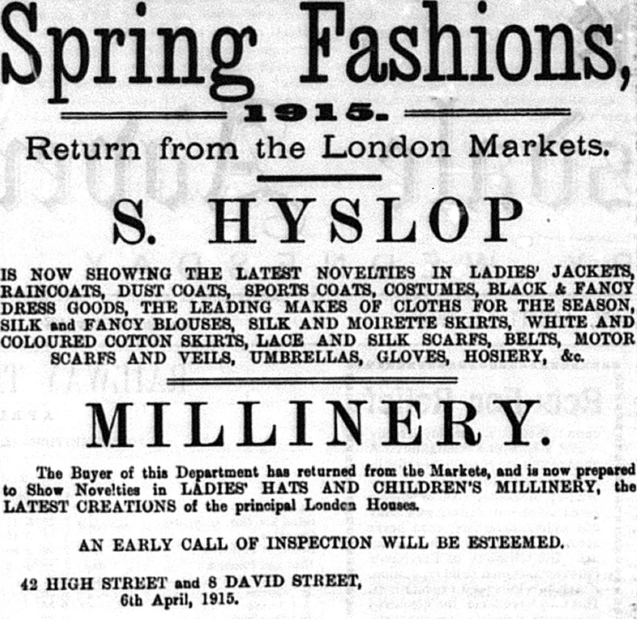
The millinery department sold ready-made hats, whereas a specialist milliner such as Bella Pringle also made hats to order.
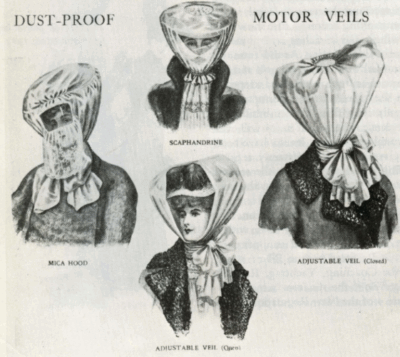
Motor cars were becoming more affordable and their open tops in the summer prompted the use of ‘motor veils’, included in the advert above and illustrated below.
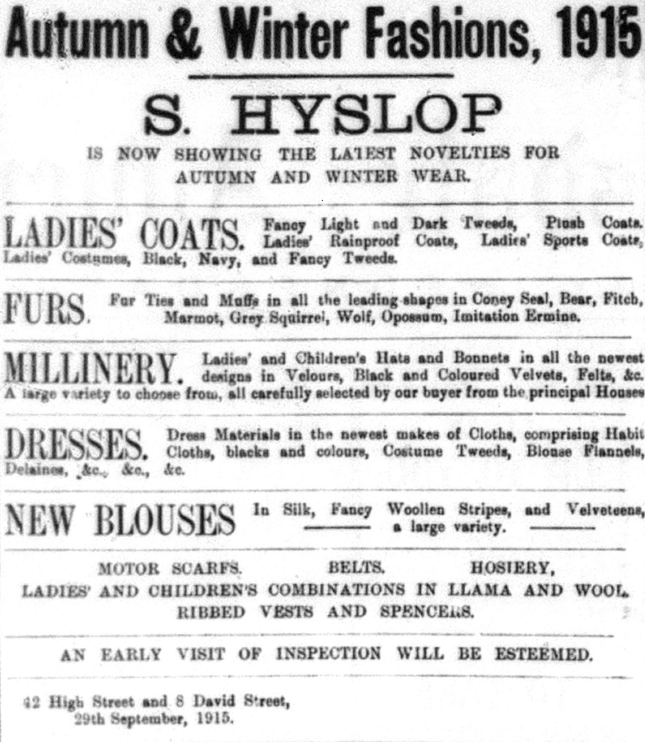
Fur clothing was becoming increasingly difficult to obtain during the war but Simon Hyslop still advertised items made from ‘Coney Seal, Bear, Fitch, Marmot, Grey Squirrel, Wolf, Opossum, Imitation Ermine’. ‘Coney Seal’ was usually rabbit simulating seal fur, ‘fitch’ was ferret and sometimes also polecat, and ‘ermine’ was the winter coat of the stoat.
Simon served an apprenticeship with William Little, draper and grocer, in Langholm. He then moved to Paris, where he married Eleanor Woodward (1855-1947) from Norfolk at the British Embassy in May 1880. Their first child was born in Paris, after which they relocated to Langholm, where Simon took over a High Street drapery business in 1882.
The shop had front and back entrances: 42 High Street and 8 David Street. It was owned by Arthur Bell, woollen mill manufacturer, but Simon owned other properties, including:
- A house at 31 Rosevale Street, where he lived.
- A shop and house in Market Place, rented by Luigi Pelosi, ice cream vendor.
- Sorbie Cottage in Drove Road, rented by Christopher ‘Kirst’ Elliot, tweed merchant and Common Riding fair crier.
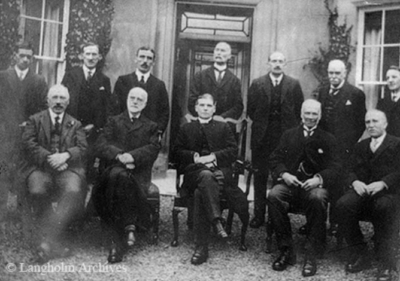
Simon was on the Golf Club committee and was beaten by Rev David Inglis in the final for the club’s Rose Bowl in 1915. He won most of the awards for carnations at the Langholm Horticultural Society show in 1913. He was an elder in the Church of Scotland Parish Church (third from right in the back row):
All three of his sons did military service:
- William (1880-1953): 1st/3rd County of London Imperial Yeomanry; former warehouseman. He was wounded by shrapnel above the eye in the Dardanelles (see 21 August 1915 in the Diary).
- John (1889-1961): 2nd Lieutenant, Royal Garrison Artillery (Anti-Aircraft).
- James (1893-1969): 2nd Lieutenant, 5th King’s Own Scottish Borderers.
After the war, William lived in Middlesex for a while, then returned to Langholm. John was a banker in Hertfordshire, then emigrated to India and died in Carlisle. James was also a banker in India, married there, moved back to Langholm and died in Jersey, Channel Islands.
Simon died in Langholm in 1928, aged 81.