Solicitors, British Linen Bank buildings
The first mention of Stevenson & Johnstone in the Langholm Archive Group’s index is in 1874. Thomas Stevenson (1827-1910) was the son of Alex Stevenson, Langholm banker and magistrate. Andrew Johnstone (1844-1906) was from Johnstone, Renfrewshire, the son of an agricultural labourer.
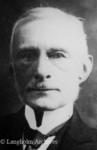
In their public notices, they referred to themselves as ‘writers’, a Scottish term for a solicitor that belongs to the Society of Writers to His Majesty’s Signet. Writers to the Signet would typically use the letters ‘W.S.’ after their names.
Both of them were also agents for the British Linen Bank, which in 1901 was the third largest Scottish bank after the Royal Bank of Scotland and the Commercial Bank of Scotland. It declined through lack of acquisitions and was acquired by Barclays in 1919, then sold to the Bank of Scotland in 1969.
As well as containing the Stevenson & Johnstone offices, in 1915 the British Linen Bank’s Langholm building contained the office of solicitor and town clerk George Irving Bell.
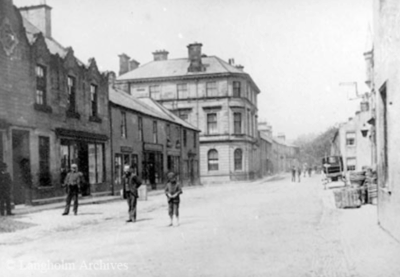
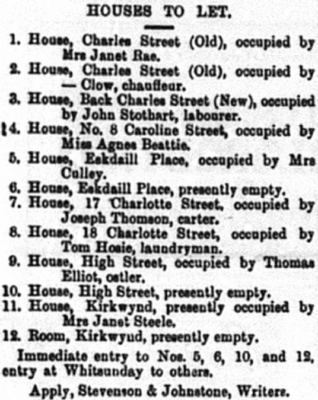
In Scotland the functions of solicitor and estate agent are often combined, and in 1915 Stevenson & Johnstone were particularly busy in the property business because of all the relocations caused by the war.
Stevenson & Johnstone were secretaries to the Eskdale and Liddesdale Agricultural and Pastoral Society.
Thomas Stevenson was a sheriff clerk depute (deputy) for small debt claims, president of the Old Town Bowling Club, chairman of the Langholm Gas Company and a founding member of the Langholm branch of the Liberal Association. His son Alexander was a 2nd Lieutenant in the 1st Munster Royal Fusiliers and died in India in 1909, aged 22.
Andrew Johnstone was town clerk and a supporter of the Conservative and Unionist party. He died single in Maxwelltown, Dumfriesshire.