Drove Road
The Hosie brothers’ main business was a steam laundry. Tommy (1874-1917) and Archie (1891-1922) also offered carpet beating and firewood.
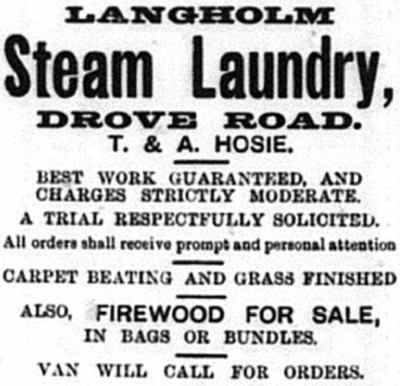
A ‘steam laundry’ referred to the source of energy, using steam to power the washing machines, rather than to cleaning with steam.
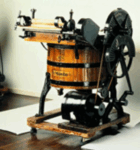
Commercial steam laundries provided some relief from manual washing for those who could afford it. At home, washing was typically done using tubs, washboards and wringers. Various washing devices were available, such as Germany’s Miele machines (hand-cranked and electric), but were not common. The UK imported some US equivalents on a small scale.
Wealthy families with estates usually had their own laundry, such as the Berkley Matthews of Westerhall, near Langholm:

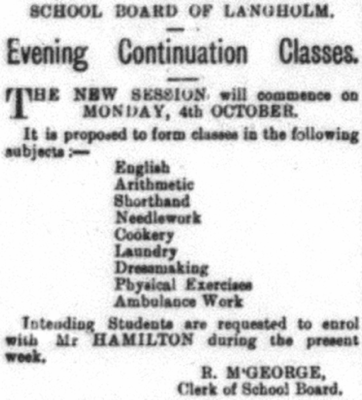
Laundry was offered as part of Langholm School’s continuation classes, but there was insufficient interest for it to proceed.
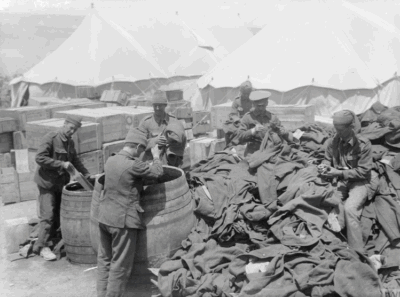
Near the trenches, field laundries provided the vital services of disinfecting and washing soldiers’ clothes. A basic device for sterilisation was the Serbian barrel, in which moist clothes were heated to disinfect them.
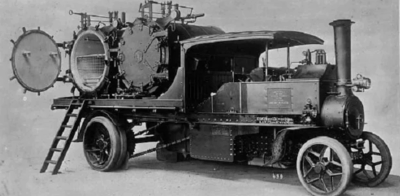
The Thresh Disinfector Company of London provided mobile sterilisation chambers, mounted on a Foden steam wagon which used pressurised steam made from a calcium chloride solution.
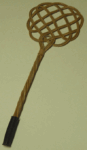
Carpet beating was done manually using an implement made from one of various types of wood.
American Melville Bissell patented a manually-operated carpet sweeper in 1876. This was followed by devices using a manually-generated vacuum in the late 1800s, then electric vacuum cleaners from the early 1900s. However, these were rare and not fully effective on carpets with years of ingrained dirt and soot.
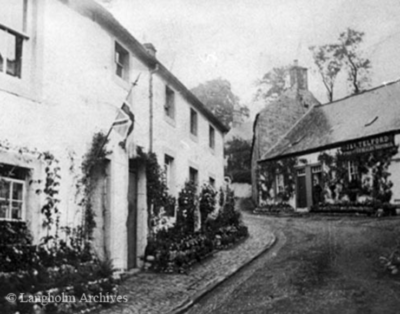
As children and younger adults, Tommy and Archie Hosie moved around the Scottish/English border area, prompted by their father changing jobs in the woollen industry. They ended up in Langholm, with the two sons taking over a laundry started in 1907 by Robert Prentice.
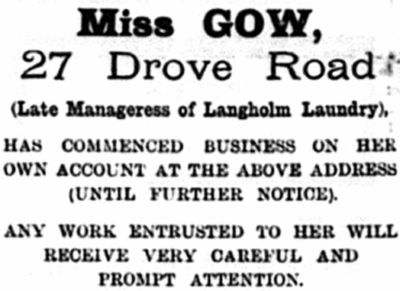
Their former manager Mary Gow set up her own laundry business, very close to the Hosies’ operation.
On 8th January 1917, a Monday morning, Thomas climbed a ladder to fit a belt on a rotating wheel but got his arm caught. His arm was dislocated and his shoulder and some ribs were broken. He was taken to the Thomas Hope hospital where the arm was amputated. He remained cheery but died of shock the next morning.
Rev James Macdonald paid tribute to him the following Sunday in the South United Free Church, saying he was a ‘steady, conscientious and painstaking workman. He was a kind husband and son, and a faithful friend’.
Later the same month, Archie was called up and sold his horse and equipment, including a dogcart. A ‘dogcart‘ was pulled by a horse but was so named because it was originally designed to carry shooters and their gun dogs.
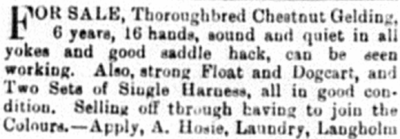
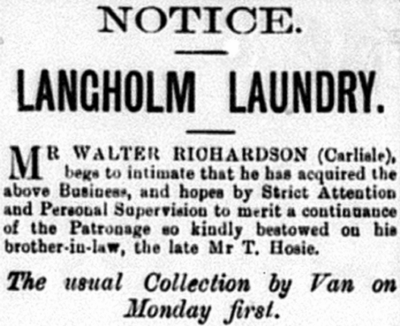
Archie was posted to Salonica, Greece, with the Royal Field Artillery and the laundry business was bought by the Hosie’s brother-in-law, Walter Richardson from Carlisle.
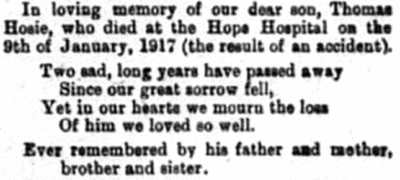
On the second anniversary of Thomas’s death, his parents placed a notice in the paper.
Archie contracted severe malaria in Greece and was transferred to France to be out of a malaria zone. He was demobilised in March 1919 and died in Longtown, just over the English border, in 1950.