47 High Street
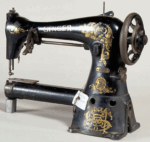
Shoes were mass produced in the UK since the early 1800s, prompted by the need for military boots for the Napoleonic wars and facilitated by the use of sewing machines from the mid-1800s.
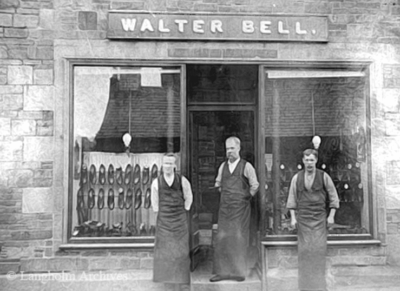
Nevertheless there was still strong demand for locally-made footwear from shoemakers such as Walter Bell (1850-1927), as well as repairs. Walter is in the middle, below, with his nephew Jim on the right of the photo and assistant Robert Laidlaw on the left.
Major suppliers of shoes in the UK included:
- Manufacturers:
- Edwards and Holmes (Norwich)
- Simon Collier (Northampton)
- Tricker’s (Northampton)
- Retail chains:
- Freeman Hardy & Willis (based in Leicester)
- Stead & Simpson (Leicester)
- Saxone (Kilmarnock, Ayrshire)
Men’s footwear consisted mainly of lace-up ankle boots, Oxford shoes (sometimes known as Balmoral shoes in Scotland) and brogues, which have patterned indentations in the leather, originally to facilitate faster drying when wet.
Women typically wore lace-up or button-up boots, either to the ankle or the mid-calf; a female version of Oxford shoes; and ‘Mary Janes’ for evening wear, which have a single strap across the front. Mary Jane was a character in American Richard F. Outcault‘s Buster Brown cartoon strip who wore this type of shoe, although in a very simple children’s style.
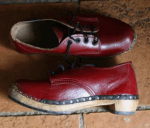
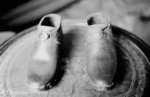
Clogs were also widespread, particularly in working settings for adults and more generally for children. British clogs often had a leather upper and a wooden sole, usually with a thin layer of metal underneath to prevent wear, as distinct from wholly or mostly wooden Dutch clogs. Some tradesmen specialised in these, known as ‘cloggers’.
Walter’s wife Margaret Laidlaw (1852-1878) died in February 1878, aged 26, followed two months later by their infant child. He moved his shop from 20 Charles Street (Old) to 47 High Street in 1898. He did not remarry and died in Langholm in 1927, aged 77.
< Post office … Solicitors >