Stationer, printer, E&L publisher and shipping line agent, 48 High Street
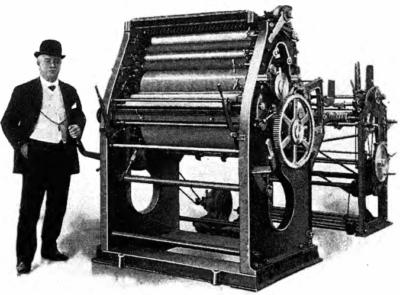
By 1915, many newspaper printing presses used offset lithography technology, invented in 1903 by Ira W Ruben in New Jersey. Lithography existed since the late 1700s, using the principle of oil and water not mixing, but Ruben discovered that transferring (‘offsetting’) the image from a plate to a rubber blanket and then to paper produced better results than direct contact between the plate and paper.
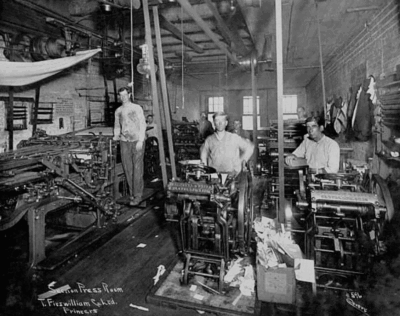
Smaller ‘jobbing’ presses, using movable metal type, were often used for stationery, leaflets, cards and posters.
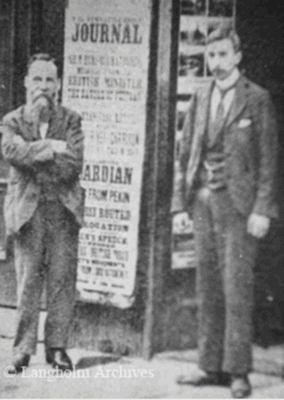
Walter (‘Wattie’) Wilson (1843-1918) was born in Liverpool but by the time he was eight his parents had moved back to his mother’s home town of Langholm. His father was a joiner from Canonbie, near Langholm.
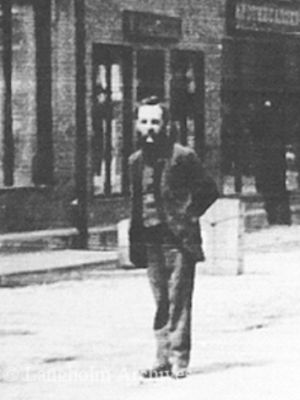
At age 25, he opened a book and stationery shop and over the years added a printing business and agencies for shipping lines. He bought the Eskdale & Liddesdale Advertiser in 1886.
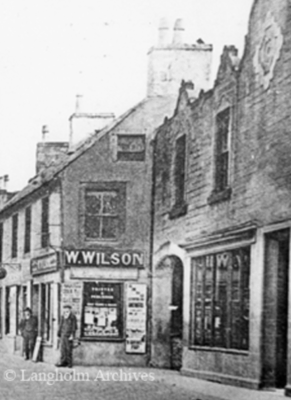
He was a gregarious, eccentric character with a limp and was very engaged in local affairs:
- Parish councillor.
- Treasurer of the local freemasons’ lodge.
- A director of Langholm Gas Company.
- Member of the Eskdale Unionist Association.
- Member of the North United Free Church, including serving as a Sunday School teacher and treasurer.
Walter’s landlord was provost Thomas Easton (1860-1928), meaning that he may have had to be a little careful when commenting on controversial civic affairs, such as provost Easton’s accusation of councillor Montgomery of vote-rigging (see 8th April 1915 in the Diary) and the provost’s refusal to participate in the 1915 Common Riding (see 22nd July 1915 in the Diary).
Walter’s assistant was Andrew (‘Dan’) Little (1882-1939), son of a woollen spinner.
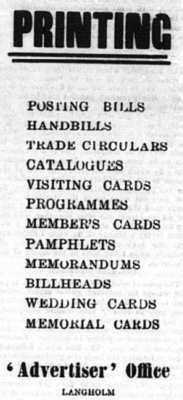
Walter Wilson’s overlapping businesses provide considerable efficiencies. He could place as many adverts as he wanted for his printing and stationery businesses in his own newspaper, filling up any empty spaces.
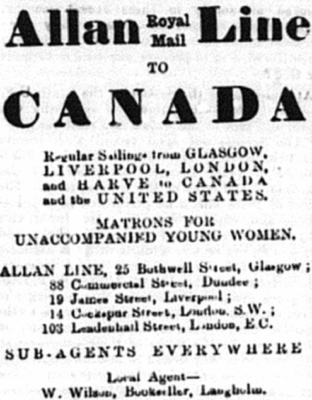
He could also freely promote his role as as an agent for passages around the world on various shipping lines. One of his agencies was for the Allan Line to North America, which provided ‘matrons for unaccompanied young women’.
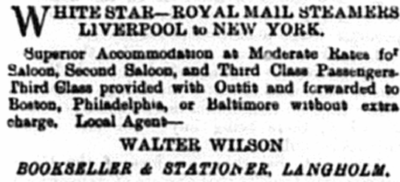
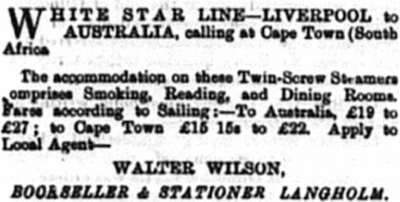
Another of his agencies was for the White Star Line to New York, offering ‘Superior Accommodation at Moderate Rates’ to New York, including the provision of an ‘Outfit’ and free further passage for Third Class passengers.
White Star’s passages to Cape Town and Australia provided smoking, reading and dining rooms.
Canadian Pacific Railway Company had a shipping subsidiary, Atlantic Steamship Lines.

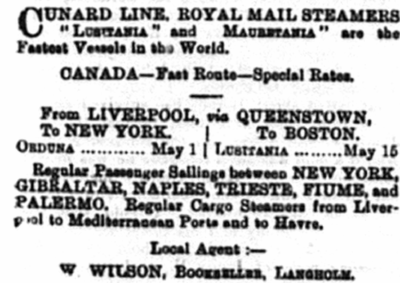
The advert for the Cunard Line below includes a sailing on 15th May 1915 to Boston, USA, by the Lusitania, one of the two ‘Fastest Vessels in the World’. It never took place, due to the Lusitania being sunk by a torpedo attack (see 7th May 1915 in the Diary), resulting in the death of a Langholm-bound passenger.
Walter died on 1st November 1918, ten days before the war ended, at the age of 75, the oldest shopkeeper in the High Street at the time. His neighbouring shopkeeper Joe Anderson, watchmaker, died less than two months later, ending two long-term High Street presences in quick succession.
Walter’s assistant Andrew Little (1882-1939) succeeded him and ran the Eskdale & Liddesdale Advertiser until his death in 1939. Andrew’s first wife Jane Graham died in 1922 at age 41; his second wife was Fanny Morrison, daughter of Langholm’s registrar Thomas Morrison.
< Solicitors … Watchmaker >