In 1915, education in Scotland was compulsory to age 14 and in England to age 12, raised to age 14 in 1918.
Langholm had an Infant School (ages 5 to 7) and an Academy (ages 8 to 16), with a total of 485 pupils.
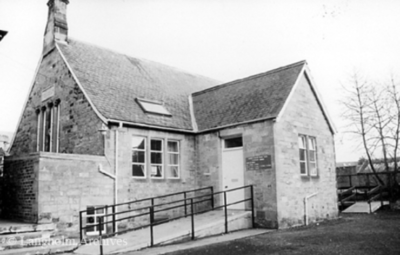
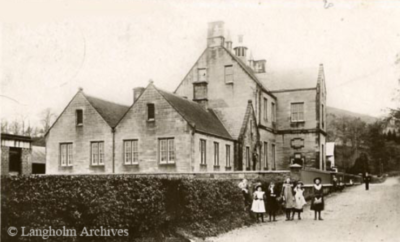
After Classes I to VI in the academy, the ‘Supplementary Class’ provided vocational training for leavers going straight into workplaces and the ‘Higher Grade’ prepared them for college or university. A Scottish Leaving Certificate was awarded to those who passed the required exams at age 15 or 16.
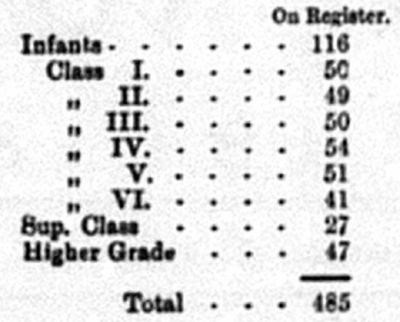
Attendance was closely tracked each week, which was usually in the region of 85 percent. Attendance prizes were awarded at the end of each calendar year but infectious diseases and disruption caused by the war resulted in lower-than-average awards:
- First prize (never absent): 29 pupils.
- Second (absent fewer than five times): 22.
- Third (absent fewer than 10 times): 24.
Both schools were under the direction of the Langholm School Board, instituted in 1876 when the infant school, the parish school and the local Free Church school were amalgamated. The reorganisation was required by the Education (Scotland) Act 1872 which transferred the supervision of education from mostly church-based organisations to elected school boards.
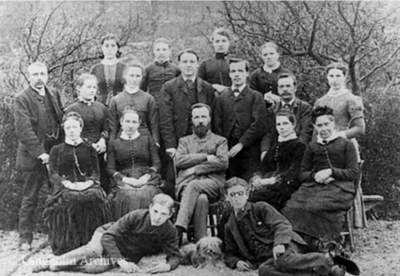
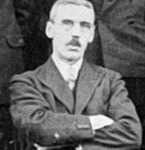
The newly-constituted Academy’s first rector was John Howie (1845-1908), born in Ayrshire, in the centre of the photo below.
He was succeeded in 1908 by Robert Hamilton (1878-1960), a science teacher who married two of the daughters of Charles Paisley, skinner (tanner). His first wife Mary and son died in 1907, after which he married Maggie in 1910.
The Langholm School Board in 1915 comprised:
- President: Arthur Bell, owner of Buccleuch woollen mill.
- Members:
- James Harkness, retired coal agent.
- Rev David Maxwell, Broomholm.
- Thomas Moses, tweed designer.
- Robert Ramage, painter.
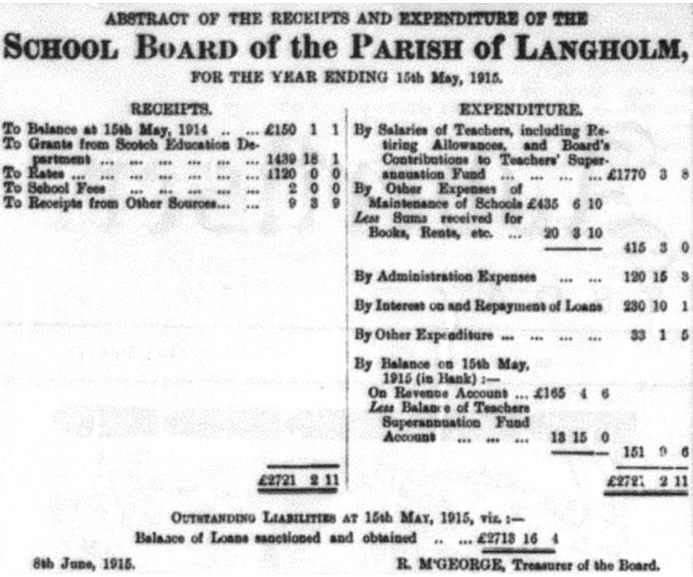
From the accounts below for the year ending 15th May 1915 (Whitsunday), it can be seen that the School Board income came mostly from grants from the Scotch Education Department* in London (£1,439) and from some of the rates collected by the Parish Council (£1,120). School fees were abolished in 1890.
* This moved to Edinburgh in 1918 and was renamed as the Scottish Education Department.
The school provided periodic medical and dental inspections of pupils, with any follow-up treatment normally being the responsibility of their families.
The Academy provided evening continuation classes to the public which covered needlework, cookery, shorthand and Division 1 (reading, writing and arithmetic). There was insufficient demand for some other subjects that were offered: laundry, dressmaking, physical exercises and ambulance work.
The academy gymnasium was sometimes used by other organisations in the town, such as the Girl Guides.
Sculptor and writer David J Beattie, a former pupil of Langholm Academy, donated a sundial to the school in June 1915, inscribed Fugit Hors (‘the hour flies’).
The top academic pupil was awarded the Dux prize, a gold medal. It was won in 1915 by May Dinwoodie, daughter of William Dinwoodie, gardener at the Broomholm estate owned by Rev David Maxwell. Around 85 other pupils won first, second and third academic prizes.
Another prestigious prize was the Hannahfield Bursary which provided £10 per year for three years of college or university education. The bursaries were very limited in number and were awarded after a competitive exam, open to residents of Dumfrieshire, Kirkcudbrightshire and Wigtownshire. The awards were derived from the estate of the family of John Hannah (1761-1841) which made its fortune in Hannah’s Town, Jamaica (later part of Kingston). Margaret Montgomery, daughter of Alexander Montgomery, hairdresser, won a bursary in 1915.
< Civic governance … Fire service >