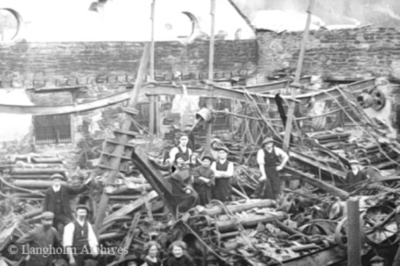
Fire was a constant danger due to the use of gas for power and lighting, electricity sparks, exposed flames from solid fuel fires, and large quantities of flammable materials in the woollen mills. Arthur Bell’s Buccleuch mill, for example, had a large fire in one of its departments in 1912.
Langholm had Scotland’s second ever steam-powered fire engine, with Glasgow having the first and third, and Edinburgh the fourth, replacing manually-powered pumps. Prompted by recurrent fires, Langholm purchased a ‘First Grand Prize Patent Steam Fire-Engine’ from Messrs Merryweather & Sons in 1871 for £450, raising funds by subscription. It was known as ‘The Esk’, after the local river.
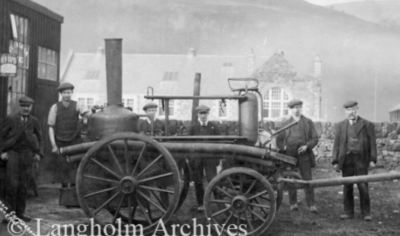
It gave a public display on the day of its arrival, putting out a large bonfire in front of a crowd of 2,000, under the command of Henry Graham of Reid & Taylor. It was horse-drawn, used suction hoses to extract water from the rivers and took about seven minutes to generate sufficient steam for the pump.
It was retired in 1913 after 42 years and became a museum exhibit in nearby Hawick.
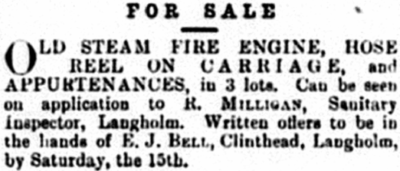
Meanwhile, improvements to the local water supply meant that potential fires could be extinguished by attaching hoses to the mains rather than by using a steam engine and river water.
However, the fire brigade’s equipment was scattered across different locations and in early 1914 councillor Major Edward Bell obtained the approval of the town council to modify a building in the High Street for a central storage space.
A fire broke out at Eskdale mill in April 1914 and was extinguished with the assistance of the fire brigade and local residents, but a large amount of yarn was destroyed, partly from water damage.
A fire in January 1915 destroyed an outhouse at Craigcleugh, the residence of Sir Spencer Ewart, commander of Scottish forces (see 26th January in the Diary). The fire brigade and police attended, but could do nothing without a suitable water supply.
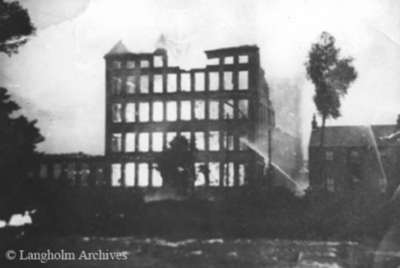
Despite Reid & Taylor being an early supporter of a fire service, much of its huge mill (known as ‘the Factory’) was destroyed by fire in 1933.
Many fire engines today carry around 1,800 litres (475 US gallons) of water for small fires, in addition to having the ability to use fire hydrants and other water sources, such as rivers and ponds.