1. Police
As a police burgh, Langholm had its own resident police force and a police court which held sessions on Saturdays for minor crimes. Sentences were usually a fine with the alternative of a short period in a prison cell for those unable or unwilling to pay the fine.
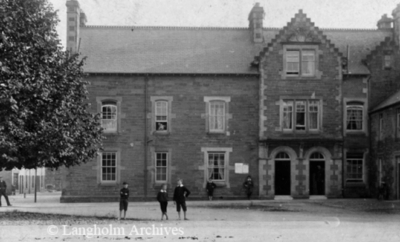
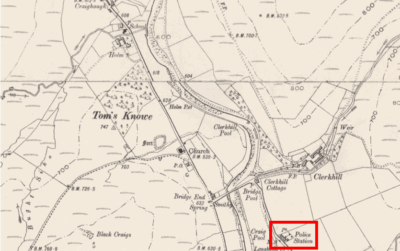
The police station, built in 1896, was in Buccleuch Square in the New Town. It had two prison cells and in addition to its law and order activities operated a lost and found service.
Crimes outside the police burgh’s jurisdiction were usually tried in Dumfries, such as a murder case in 1916 involving three workers staying near Langholm (see Glentarras Distillery).
Below are two examples of local cases in 1915:
| Date* | Accused | Charge | Sentence |
|---|---|---|---|
| 21 Apr | Jane Norris or Johnstone of no fixed abode | Assault and breach of the peace | Fine of 7s 6d or 10 days’ prison (latter chosen) |
| 23 Jun | Margaret Mallison or Smith of no fixed abode | Drunk and disorderly | Fine of £2 or 20 day’s prison (latter chosen); her 44th conviction in Langholm. |
* Date of being reported by the E&L.
There were five local policemen in 1915, all of whom had police accommodation in Buccleuch Square, except the youngest. The most senior, Sub-Inspector William Graham, had previously worked in various other stations in the region.
| Name | Rank | Born | Age |
|---|---|---|---|
| William Graham | Sub-inspector | Ewes, Dumfriesshire | 56 |
| William Hornby | Police constable | Dalbeattie, Kirkcudbrightshire | 29 |
| William Irving | Police constable | Canonbie, Dumfriesshire | 27 |
| Joseph Cook | Police constable | Kirkmichael, Dumfriesshire | 24 |
| Frank Cook | Police constable | Applegarth, Dumfriesshire | 22 |
Joseph Cook joined the Scots Guards but the other constables of military age were retained for police work. After the war, Joseph transferred to nearby Eskdalemuir. This sparsely-populated settlement had its own station with a resident policeman, a significantly different approach from increasingly centralised policing in subsequent years.
Constable William Hornby appeared as a witness in a 1917 trial in Dumfries of a farmer accused of charging more than the government-stipulated maximum for potatoes. Robert Bell of Greenrigg farm, Canonbie, was found guilty of overpricing a hundredweight (50 kilograms or 112 pounds) sold to John Ewart, a blacksmith in Langholm, and was fined £5.
The E&L reported a ‘Langholm Lady’s Loss’ in July 1915 when Mrs Matilda Scott-Elliot of Arkleton house had jewellery of substantial value stolen from her on the Edinburgh to Aberdeen train (see 9th July in the Diary).
Dumfriesshire’s chief constable was William Gordon from 1891 until retirement in 1932. He was born in Forgue, Aberdeenshire, and worked mainly in Lanarkshire before moving to Dumfriesshire.
2. Licensing
The alcohol licensing court sat twice a year (April and October) to decide on alcohol licences.
Justices:
- Moffat, Gowanlea
- Gaskell, Murtholm
- Paisley, The Holm
- Borthwick, Billholm
Clerk Elton.
Issued under the Scottish Licensing Act 1903 which allowed bona fide travellers to purchase alcohol before and after opening hours.
Other licences were handled by the town council, for abattoirs, entertainment premises, the cinema and the sale of poisonous goods.
< Health … Observatory >