The Episcopal chapel was built in 1883 by the 5th Duke of Buccleuch (1805-1884) in the grounds of his Langholm estate. It was designed by local architect James Burnet.
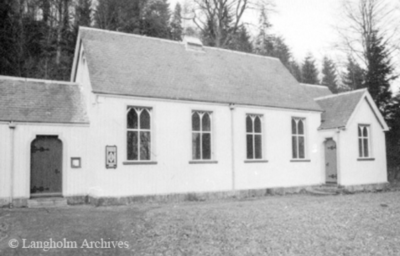
In his autobiography The Fleeting Opportunity (1940), the 6th Duke’s son Lord George Scott described how the chapel came into existence. In the absence of a local Episcopalian church, Lord George’s mother used to arrange Episcopalian-style services in Langholm Lodge’s dining room after Sunday lunch had been cleared away. His father reluctantly conducted the services, very poorly, much to his own and everyone else’s embarrassment. After a particularly bad service, he decided that a chapel should be constructed and a chaplain appointed, relieving everyone of the awkwardness.
Chaplains until just after the war were:
- Philip Lockton. 1886-1893. Born in Tasmania. He married Aldyth Stansfeld, granddaughter of local dignitary Colonel William Borthwick, Longwood. A keen member of Langholm Cricket Club.
- Wilson White. 1893-1903. Cricketer, golfer, curler. Left Langholm to assist his ill father.
- John Seaton. 1903-1917. Previously an assistant at St Paul’s Anglican Church, Carlisle. Co-founder of the Langholm Tennis Club. Transferred to Doddington, Lincolnshire.
- Roger Hodge. 1918-1920. Formerly an army chaplain in India.
Once the chapel had been founded, it attracted various members of the community, including:
- Clement Armstrong: coal agent; president of the local Archaeological Society, Horticultural Society and Burns Club.
- John B Balfour: grocer and choir conductor.
- Charles Carruthers: watchmaker.
- Fred Graham: owner of Reid & Taylor mill.
- James Scott: owner of Kilncleuch mill.
In 1914, the chapel was converted from being a private institution into a fully-fledged Scottish Episcopal church, with occasional visits from the Bishop of Glasgow.
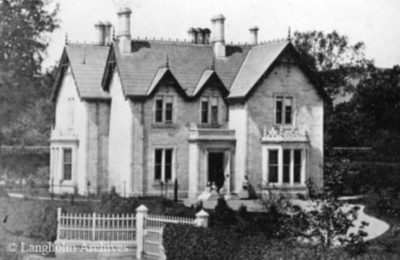
The church’s parsonage was initially at Bridge House from 1886, then at Eskbank, built in 1870 for Wauchope mill owner George Bowman, who died two years later. Eskbank was demolished in 1962 to make space for a new school building.
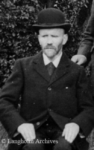
The organist for over 40 years was John Beattie (1835-1925), known as ‘Blind John’, who gave organ, piano, harmonium, singing and music theory lessons.
The early wartime chaplain, Rev John Seaton, also conducted Sunday services at the Red Cross Hospital. Although the hospital was in a Church of Scotland property, its church affiliation was suspended during the war, prompting the Church of Scotland to seek recuperation of rates, perhaps unsuccessfully. The hospital was run by Lady Ewart, an Episcopalian.
The church’s Roll of Honour of those who served in the Great War has 36 names: 18 served in the army and seven in the navy; seven were killed in action and four were discharged through ill health.
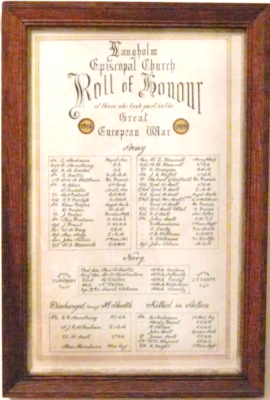
Those killed included:
- John Scott: eldest son of James of Kilncleuch mill, on 15th November 1914 in France.
- Hardy Grant: son of Annie Grant, Buck Hotel keeper, in the Gallipoli campaign (see 24th August 1915 in the Diary).
- James Scott: second son of James of Kilncleuch mill, on the first day of the Battle of Loos, France (see 25th September 1915 in the Diary).
The church celebrated its 100th anniversary in 1983, attended by the 9th Duke of Buccleuch and family members, including his aunt Princess Alice, Duchess of Gloucester, who planted a tree.
It closed in 1996 and was temporarily the home of the Armstrong clan museum, now located in Gilnockie Tower, five miles south of Langholm.