As well as providing opportunities for trading and entertainment, fairs enabled the owners of baronies (such as the Duke of Buccleuch) to impose charges on participants, such as tolls for each stall erected and each animal sold. To do this, the fairs had to be approved by parliament and formally proclaimed in advance by the organisers, typically by means of a public crier.
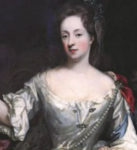
Until 1701, Langholm had four statutory fairs, in addition to a weekly market, the most important of which was the Summer or Lamb Fair in July. The 1st Duchess of Buccleuch (1651-1732) petitioned successfully to add two more. Initially the Summer Fair was on 15th July but in 1752 this moved to 26th July when the UK changed from the Julian to Gregorian calendar, adding 11 days to previous dates. The others were held on specified dates in April to October.
The Common Riding was held on the day after the Summer Fair, and over time the ‘crying of the fair’ became part of the Common Riding ceremony, even though the two events did not necessarily need to be linked. The wording of the Common Riding version of the proclamation came to differ significantly from earlier forms, adapted to incorporate the upholding of community rights.
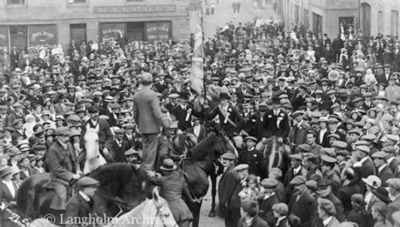
The weekly market was originally held on Thursdays but was later changed to Wednesdays.
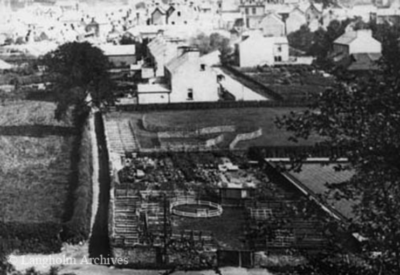
Livestock auctions were held periodically in Langholm by the firm R Harrison & Son of Carlisle. The auction site with a ring and pens can be seen in the foreground of the photo below. To the right is the green of the Old Town Bowling Club.
< The Common Riding … Businesses >