A number of Scottish border towns have an annual ceremony of ‘riding the marches’, i.e. patrolling boundaries, symbolising the protection of town and common land from encroachment. Each town has a different form of ‘common riding’, incorporating its own traditions.
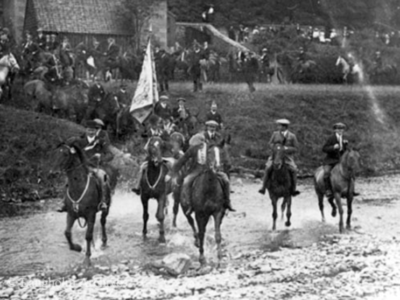
In Langholm, some of the traditions date back to 1759, when the Court of Session in Edinburgh ruled that part of the land in and around Langholm belonged to the community. This area was then delineated using existing or newly-created landmarks and is ceremonially patrolled once a year. This took place from 1759 on foot, then from 1816 on horseback.
By the early 1910s, the Langholm Common Riding included:
- The welcoming of Langholm diaspora off the last train the evening before the main day, led into town by the Flute Band and followed by the Pipe Band.
- An early morning parade by the Flute Band on the day itself.
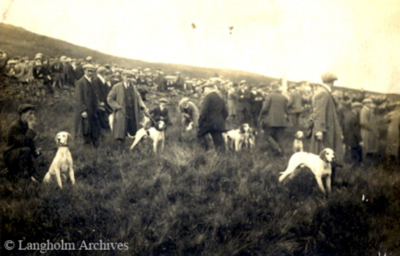
- A hound trail (foxhound race, following a scent) on a nearby hillside.
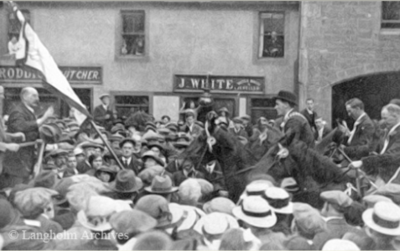
- The Provost’s handing over of the town’s standard (flag) to the cornet (ceremony leader) on the Common Riding morning and receiving it back at the end of the day. The cornet is selected by a vote held in a meeting a number of weeks before the event.
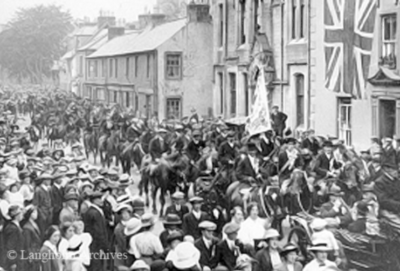
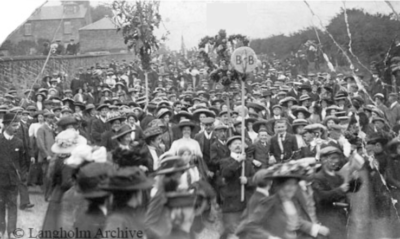
- A procession round the town, led by the Town Band and the cornet.
- The display of emblems: a barley bannock with a salted herring nailed to it, a spade, a large thistle and a crown.
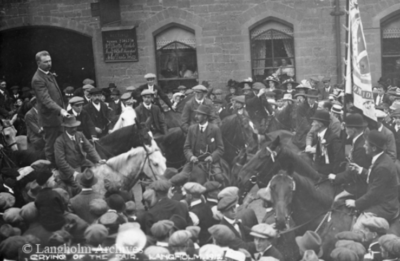
- The first ‘crying of the fair‘ in Market Place, a proclamation made by a crier standing on the back of a horse. A second crying of the fair takes place on a hillside above Langholm shortly afterwards and a third is performed in Market Place later in the morning.
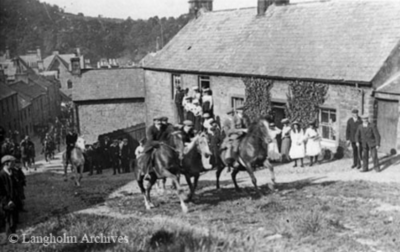
- A gallop up the steep Kirk Wynd and Mount Hooley, led by the cornet.
- The cutting of sods with an emblematic spade at particular locations.
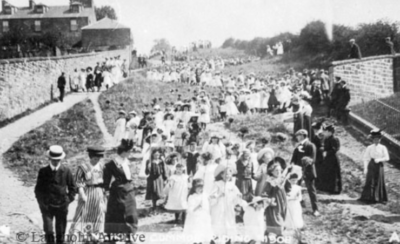
- A parade of schoolchildren with heather besoms (brooms).
- The cornet’s chase on horseback: he is given a head start and others try to catch him.
- Cumberland wrestling, horse racing and sports events, which previously included climbing a greasy pole and chasing a well-soaped pig.
- Dancing on the Castleholm and in the High Street.
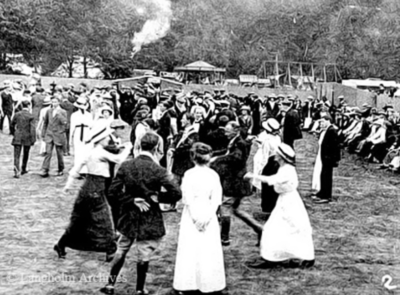
Dancing on the Castleholm, with fairground entertainment in the background
A major controversy broke loose in 1915 when the Common Riding committee recommended cancellation of the Common Riding due to the war. See 11th May in the Diary through to the end of July.