As with carpet bowls, lawn bowls was very popular in Scotland. Langholm has two clubs: Old Town and New Town, founded in 1853 and 1857 respectively. There was limited tournament bowling in 1915.
The sport dates back to the 13th century. In the modern era, the Scottish Bowls Association was formed in 1892 and the English Bowling Association in 1903, adopting Scottish rules. The first president and captain of the English association was the well-known cricketer W G Grace (see his death on 23rd October 1915 in the Diary).
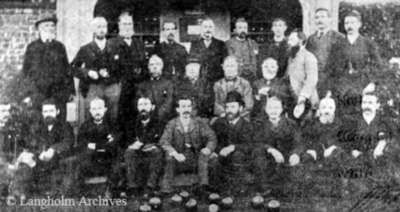
In 1903, W G Grace organised the first intra-UK international bowls competition, captaining England to victory. Despite the sport’s ancient origin, there was no formal world championship until 1966, held in Australia.
Old Town
The Old Town green is below, with the Parish Church and woollen mill chimneys behind it. The club’s original green became a lawn at the Thomas Hope Hospital in the centre of town after the club moved in 1894.
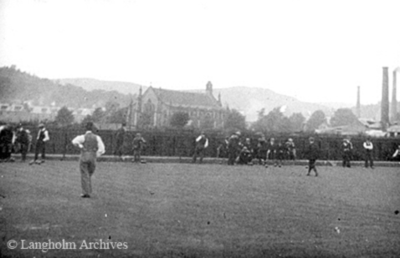
The Old Town club admitted lady members for the first time in 1915. The season was opened with a tea party at which the president Robert Ramage gave a speech welcoming ladies and addressing wounded soldiers recuperating at the Red Cross Hospital. He was later accused of double standards for holding bowling club festivities but then instigating the cancellation of the town’s Common Riding.
Old Town officials in 1915 were:
- President: Robert Ramage, painter, replacing John Ewart, blacksmith
- Vice-president: A King, Canonbie
- Secretary and treasurer: Eddie Harkness, clerk
- Committee: Joe Anderson, watchmaker; Thomas Common, joiner; James Dalgliesh; John Ewart, blacksmith
New Town
The New Town club’s original name was the Langholm Working Men’s Bowling Club, with its green situated next to Langholm Academy. It purchased the green from the Duke of Buccleuch in 1915 for £31 5s (£2,700 today), with a provision that it can be repurchased by Buccleuch for the same price if the land ceases to be used as a bowling green.
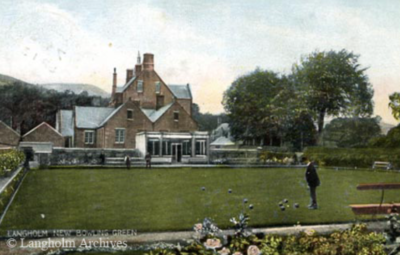
The New Town officials were:
- Honorary president: Arthur Bell, woollen mill manufacturer
- President: Robert Glover, gardener, replacing James Petrie, baker
- Secretary: Hugh Robson, customs and excise officer
- Treasurer: James Morrison, registrar
- Committee: William Park, grocery salesman; Thomas Hounam, tweed designer; Robert Brodie, timekeeper*; Elliot Little, millworker; Sam Smith, tailor; James Connon, hotelkeeper
* A woollen mill role, sometimes combined with gatekeeper.
< Carpet bowls … Cricket >