Langholm Tennis Club was founded in 1904 but was closed during 1915 due to the number of members away on war service. However, it could still be used by members if they made the courts ready for play themselves. Robert Paisley, tanner, was president and Rev John Seaton of the Episcopal Church was secretary and treasurer.
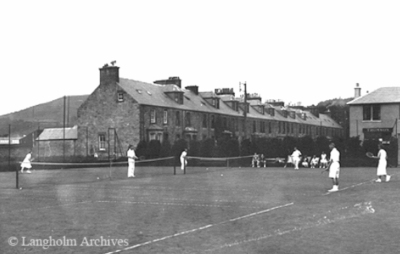
1914 fixtures included ladies’ and mixed matches against Courtfield and a mixed match against Longtown. Players included:
- Men: Rev John Seaton, W M Coulson, T Lightbody, T Paisley, Robert Hamilton (rector, Langholm Academy), Walter F Scott (woollen designer), R W Bell.
- Ladies: Mrs Dora Seaton and W F Scott; Misses Lilian McGeorge, Ella Cairns, L Thomson, J Paisley, Lizzie Burnet, Ethel Moses and Grant.
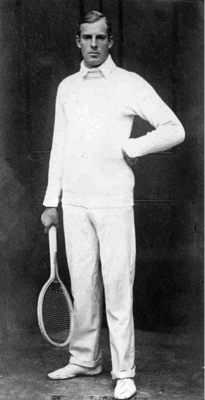
On the international scene, there was no overall world champion at the time but one of the best male players was Anthony Wilding (1883-1915), a New Zealander living in the UK. He won all three top tournaments in 1913: the Hard Court Championship in Paris, the Grass Court Championship at Wimbledon and the Covered Court Championship (which moved around Europe) in Stockholm. He was killed by a shell at the Battle of Aubers Ridge (see 9th May 1915 in the Diary), leaving his theatre director fiancee Maxine Elliott heartbroken for life (see Theatre).
The best female player was Suzanne Lenglen from France, winning the 1914 singles and doubles World Hard Court Championships. Her doubles partner was Elizabeth Ryan from the USA.
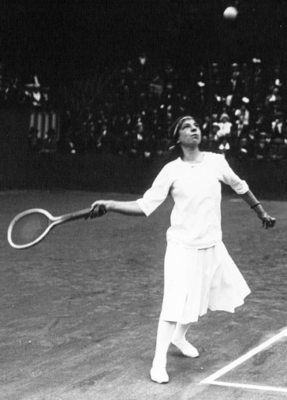
Lenglen was known for her leaping, ‘balletic’ style.
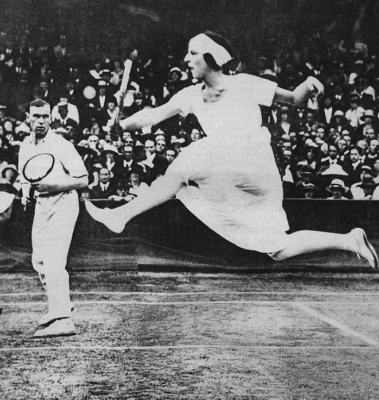
Tennis rackets (or racquets) at the time were made of laminated wood, including ash and hickory. Strings were made from sheeps’ intestines. Balls were rubber with a felt or cloth cover and were unpressurised until the 1920s, when air was injected into them.