Theatre, like other types of ‘leisure’ organisations, wrestled with what its wartime role should be, and its viability with depleted resources. Most UK performances were cancelled in late 1914 but the sector soon re-established itself as being primarily a morale-booster, as well as a recruitment facilitator and a fundraising method.
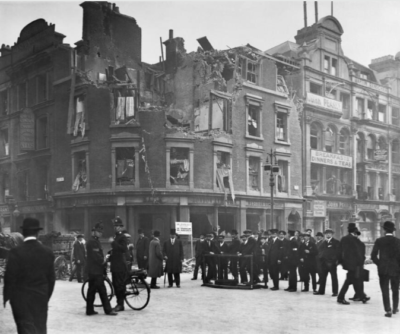
A Zeppelin raid in 1915 damaged some London theatres (see 13th October in the Diary) including The Strand, which was nevertheless able to continue its popular production of The Scarlet Pimpernel by Baroness Orczy.
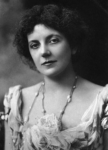
Travelling troupes put on shows in France, incorporating various performers organised by actress and theatre manager/producer Lena Ashwell (1872-1957) (see 13th June in the Diary). Ashwell was divorced in 1908 from Arthur Playfair, a distant relative of James Playfair, designer of Langholm Lodge. She married Henry Simson in the same year, an obstetrician to the royal family from around 1916 who delivered the future Elizabeth II in 1926.
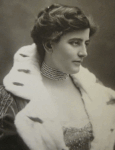
Theatre owner, actress and society hostess Maxine Elliot (1868-1940) bought a barge and delivered aid to an estimated 350,000 Belgians. Her fiance Anthony Wilding, the world’s leading tennis player (see Tennis), was killed at the Battle of Aubers Ridge (see 9th May in the Diary).
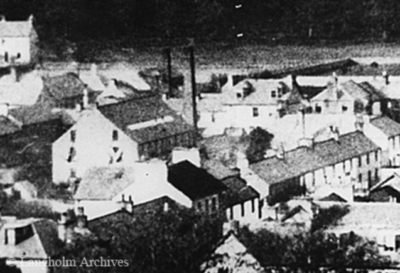
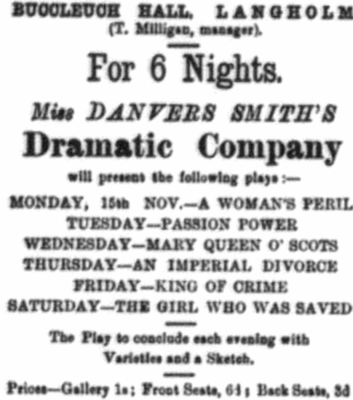
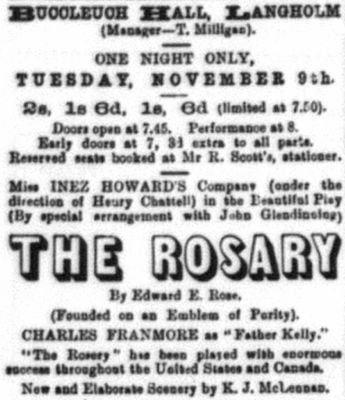
The main venue for theatre performances in Langholm was the Buccleuch Hall which was owned by the Milligan family, staging local and visiting productions.
The Langholm Amateur Dramatic Society and other local groups usually put on a few theatrical productions each year (including one or more musicals: see Music). During the war, however, larger-scale performances were mainly by visiting companies, including:
- Miss Marie Danvers Smith and her No. 1 Company of Dramatic Artistes (see 8th March and 15th November in the Diary).
- Miss Inez Howard’s company, performing The Rosary by American Edward E Rose (see 9th Nov in the Diary).
< Music … Bowls (carpet) >