1. Introduction
The top three family names in the 1911 Langholm parish census were Bell, Irving and Armstrong.
For an overview of influences on Scottish place names, see here.
2. Family names
The top 15 most common family names in the Langholm parish in 1911 were as shown below, indicating the number of individuals with the same family name.
There were 386 different family names (combining minor variations, e.g. Elliott and Elliot) in a population of 3,299.
| Rank | Family Name | Number |
|---|---|---|
| 1 | Bell | 128 |
| 2 | Irving* | 121 |
| 3 | Armstrong | 93 |
| 4 | Scott | 89 |
| 5 | Murray | 76 |
| 6 | Thomson | 75 |
| 7 | Little | 74 |
| 8 | Graham | 71 |
| 9 | Laidlaw | 60 |
| 10 | Beattie | 58 |
| 11 | Wilson | 51 |
| 12 | Elliot/Elliott** | 50 |
| 13 | Johnstone | 48 |
| 14 | Davidson | 43 |
| 15 | Maxwell | 39 |
| Subtotal | 1,077 | |
| Others | 2,222 | |
| Total | 3,299 |
* There were only 2 people with the spelling ‘Irvine’.
** There were only 3 people with the spelling ‘Elliott’.
Using the name Bell as an illustration, the Bells were a long-standing border clan which had a history of being ‘reivers’ (raiders). Many Bells were encouraged to move to northern Ireland (Ulster) in the 1600s and early 1700s as part of attempts to pacify the borders and to colonise Ulster.

Although tartan has existed for centuries, clan tartans and clan crests were largely inventions of the early to mid 1800s, partly institutionalised by the Highland Society of London. Formal registration has only existed since the Scottish Register of Tartans Act 2008. As with other clans, there are various tartans associated with the Bell name.
Clan coats of arms have a longer history but nearly all of them are informal, unregistered by the Lord Lyon King of Arms who oversees heraldry in Scotland. There are various informal coats of arms associated with different branches of the Bell clan, including the one above. Registered coats of arms are owned by individuals and not by clans.
Prominent Bells in Langholm during the war included Arthur Bell, owner of Buccleuch Mill, and his son Major Edward Bell.
3. Place names
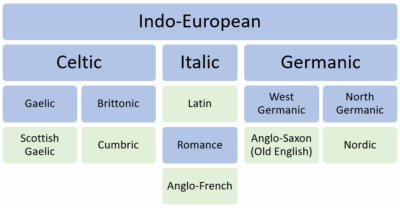
Dumfriesshire, like most of the UK, had a mix of Celtic, Roman, Anglo-Saxon, Viking and Norman influences. Some of the ethnic and linguistic categories which influenced its place names are contested, but below is a much simplified representation of the language groups and sub-groups of historical significance in the area. The green shading indicates the most significant linguistic influences.
Below is a small selection of place names and terms with possible meanings. In many cases the precise etymology is difficult to establish.
| Name/Term | (Possible) Origin | (Possible) Meaning |
|---|---|---|
| Dumfries | Scottish Gaelic Dùn Phris | Fort of the thicket. |
| Shire | Anglo-Saxon scir | An area under governance. |
| Langholm | Nordic, Anglo-Saxon, Scottish Gaelic | Lang means ‘long’. Holm came to mean ‘an area of flat land next to a river‘ but earlier meant ‘island’. There is an island called Långholmen in Stockholm, Sweden. |
| Canonbie | Latin coenobium | Priory. This could explain an earlier spelling ‘Canobie’. |
| Esk | Cumbric Isca | ‘Water’ or ‘river’. ‘River Esk’ is therefore a tautology, like ‘River Avon’ in England, where avon had an equivalent meaning. |
| Dale | Various | ‘Valley’. |
| Ewes | Scottish Gaelic uisge | ‘Water’, ‘rain’. Unrelated to ewes for sheep breeding. |
| Cleuch/cleugh | Anglo-Saxon | ‘Gorge’, ‘ravine’, e.g. Craigcleugh house near Langholm. |
| Caer | Cumbric | Fort, e.g. Carlisle, Caerlaverock. |