Langholm soldiers, both regulars and Territorials, were involved in some of the major battles of 1915 on the Western Front and in the Gallipoli campaign.
1. Western Front
| March | Neuve Chapelle, France |
| April/May | Hill 60, Ypres, Belgium |
| May | Aubers Ridge, France |
| September | Loos, France |
| Various | Other Western Front fatalities |
These four battles were at the northern end of the Western Front:
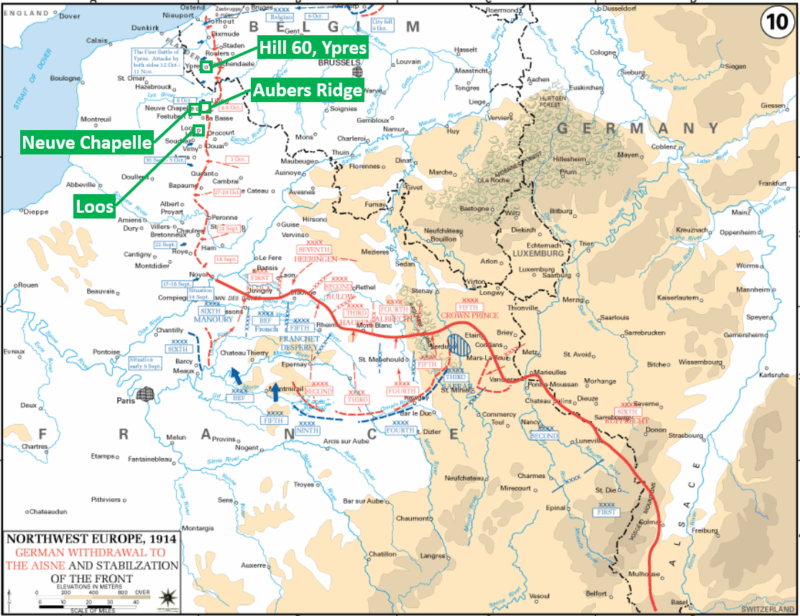
The Battle of Neuve Chapelle was the first major planned British offensive in the war, gaining a small amount of territory.
The capture of Hill 60, Ypres was part of the Second Battle of Ypres, taking back a small area which had been gained by Germany in the First Battle of Ypres in November 1914. It saw the first large-scale use of ‘poison gas’*, by Germany.
* Initially this was chlorine gas, but the term also encompassed other chemicals used later in the war, including phosgene which caused 85 percent of World War I gas deaths, and ‘mustard gas’ which consisted of fine droplets rather than being a gas. It also included tear gas which was developed for police forces from 1912.
The Battle of Aubers Ridge resulted in high losses for minimal gain and was the catalyst for the Shell Crisis in the UK about the lack of sufficient quantities of appropriate munitions.
The Battle of Loos was Britain’s largest offensive in 1915 but failed to gain significant ground. It involved the first large-scale use of Kitchener’s new recruits and saw the first British use of poison gas.
Other Western Front fatalities resulted from sniper fire and other causes outside the main battles.
2. Gallipoli campaign
| April/May | Cape Helles landings |
| June | Trench tours |
| July | Achi Baba Nullah |
| August | August Offensive |
| Various | Other Gallipoli fatalities |
The Gallipoli campaign was an attempt to open up a new front in the south-east of Europe. The Western Front had become a stalemate, bogged down in trench warfare. Winston Churchill was First Lord of the Admiralty and advocated a naval attack on the Ottoman fortifications in the Dardanelles straits, bounded to the west by the Gallipoli peninsula, with a view to gaining control of access to the Black Sea.
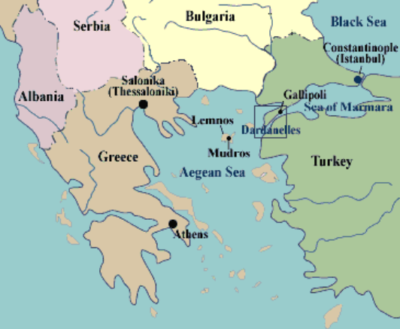
A British and French naval campaign in February 1915 failed to penetrate the heavily mined seaway, which was also protected by heavy artillery.
The governments of the Entente (UK, France and Russia) then endorsed a land campaign, which commenced in April 1915. The main participants in the attempted invasion were British and Commonwealth troops, but France also took part and Russia provided planning support.

Cape Helles landings took place at five main sites (designated S, V, W, X and Y), with 1st KOSB initially going ashore at ‘Y’ beach on 25th April 1915 and 1st/5th KOSB at ‘V’ beach on 6th June 1915.
Trench tours were undertaken by 1st/5th KOSB to forward positions at locations such as ‘Twelve Tree Copse’ and ‘Backhouse Post’.
The Battle of Achi Baba Nullah was a major encounter a short way inland from Y beach, taking two rows of trenches but at considerable cost in terms of deaths and wounds.
The August Offensive sought to break the deadlock on the Gallipoli peninsula and included the Battle of Krithia Vineyard, a landing at Suvla Bay and the Battle of Hill 60 (not to be confused with Hill 60 near Ypres on the Western Front). Only minor gains were made.
Other Gallipoli fatalities resulted from illness or wounds while in hospital care or in other action.
The casualty toll in the Gallipoli campaign was approximately as shown below, including significant French and Indian casualties, often overlooked. Evacuations were for severe sickness, mainly enteric fever (typhoid) from flies due to the number of exposed dead.
| Nationality | Killed/ Missing | Wounded/ Evacuated | Total* |
|---|---|---|---|
| UK | 41,100 | 157,200 | 198,000 |
| France | 9,000 | 38,000 | 47,000 |
| Australia | 8,700 | 18,500 | 27,000 |
| New Zealand | 3,400 | 4,200 | 8,000 |
| India | 1,400 | 3,400 | 5,000 |
| Newfoundland | 50 | 100 | 150 |
| Entente* | 64,000 | 221,000 | 285,000 |
| Ottoman* | 68,000 | 166,000 | 234,000 |
| Total* | 132,000 | 387,000 | 519,000 |
* Rounded to nearest thousand, except Newfoundland