12th July 1915
The date of 12th July 1915 is notorious in the history of the 52nd (Lowland) Infantry Division, which incorporated:
- 155th South Scottish Brigade, including 1st/4th and 1st/5th KOSB.
- 157th (Highland Light Infantry) Brigade.
By the end of the day, one third of the division had been killed or were wounded. Two 1st/5th KOSB soldiers from Langholm were killed in action and another died later from wounds. Others were seriously wounded but recovered.
Achi Baba is an area of high ground which was used by the Ottomans as their key defence base on the Gallipoli peninsula. A ‘nullah’ is a narrow gully. The Achi Baba peak and the battle area of Achi Baba Nullah, which runs southwest from the peak, are shown below.
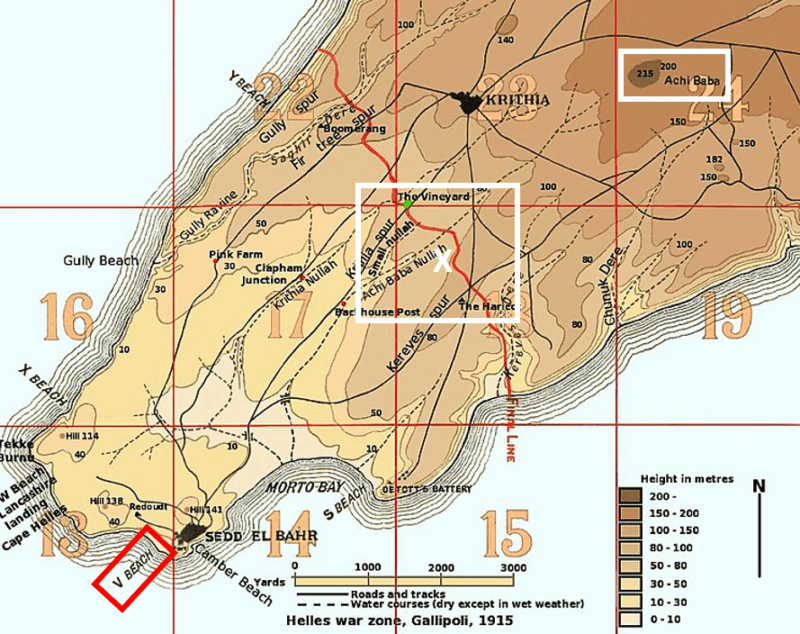
The white ‘X’ marks No Man’s Land in the trench map below
The British offensive began at 4.30 am with aerial bombardment, followed at 6.55 am by land artillery. The first of four charges across no man’s land was made at 7.35 am.
The objective of the first two charges (incorporating 4th KOSB) was to break through two lines of Turkish trenches and take the third. The third and fourth charges (incorporating 5th KOSB) were intended to consolidate the first two. Only bayonets were to be used, with no shots to be fired.
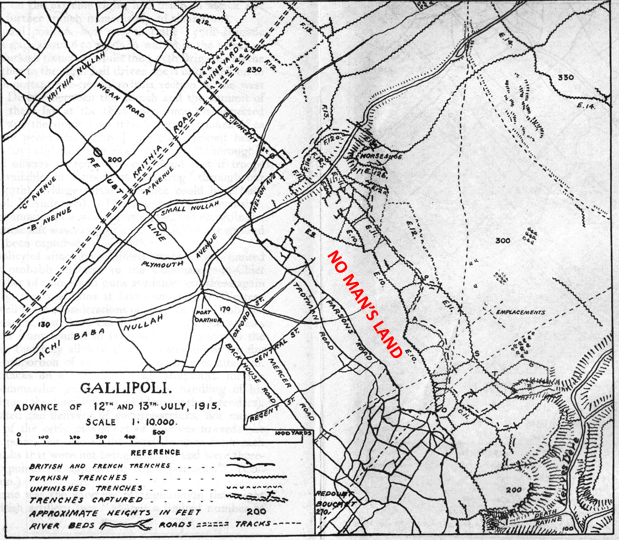
However, the third line of trenches turned out not to exist, so the attackers turned to retreat, exposing themselves to fire from behind. This was exacerbated by wearing tin strips on their backs, shining in the sun, which were intended to make them more visible to their own artillery.
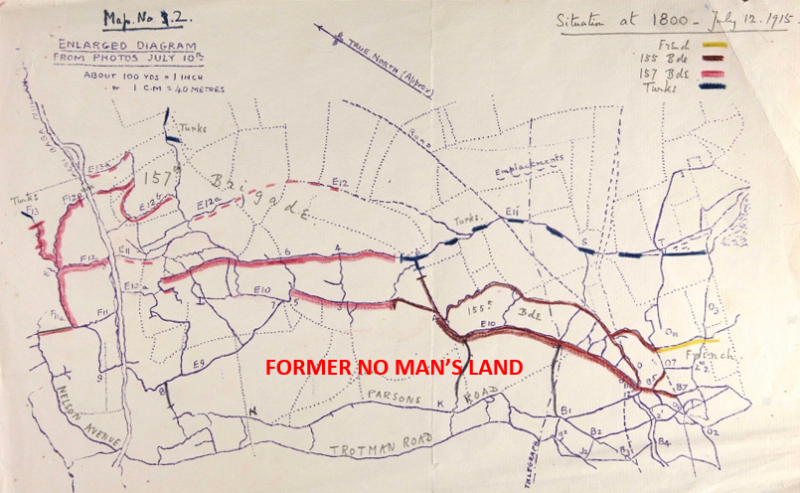
The first two lines of trenches were taken, but the casualty rate was extremely high, particularly among the 4th KOSB. The trench positions at 1800 on 12th July are shown below, with red indicating 157th brigade.
A Langholm soldier (unnamed) wrote a letter which was published in the E&L, saying:
… along the whole trench the enemy were lying two and three deep. The wounded were to be found under the dead where they had crawled for protection, and to one of the machine guns that was captured the men were chained, while there were two couches in a dug-out for German officers.
E&L, 4 Aug 1915
Major Edward Bell of 5th KOSB, in the third wave, was hit in the chest by a bullet or shrapnel while crossing no man’s land, only just missing his lung. He lay there for eight hours before being rescued by his batman.
Various Ottoman/German counter-attacks were repelled over the next two days and the trenches were held. 5th KOSB returned to the rest camp on 16th July. Their deaths totalled 11 officers and 259 men, including the three from Langholm below.
Died
| Date | Surname | Forenames | Event | Unit | Rank/No. | Age | Address | Memorial |
|---|---|---|---|---|---|---|---|---|
| 12th July | Dunbar | Charles | Killed in action | 1st/5th KOSB | Private 1938 | 21 | Greencleuch Cottage, Westwater | Helles, Türkiye |
| 12th July | Warwick | John | Killed in action | 1st/5th KOSB | Private 1115 | 19 | 8 Back Mary Street | Helles, Türkiye |
| 18th July | McVittie | Thomas | Died of wounds | 1st/5th KOSB | Private 1113 | 21 | Henry Street | Helles, Türkiye |
Charles Dunbar was the only son of George and Isabella nee Shannon. He was born in Middlebie and was a chauffeur in Brampton, Cumbria. His father was a ploughman, living in Greencleuch cottage, Westwater farm, Langholm.
John Warwick worked at the plant nursery, Langholm, a Duke of Buccleuch enterprise. He played in the Langholm Town Band and was a bugler in the army.
Thomas McVittie, son of William, a weaver, died of wounds on hospital ship HMHS Grantully Castle, after his spine was fractured by a bullet. He was buried at sea. He worked in a Buccleuch mill warehouse and is one of 21 people in the mill’s Roll of Honour.