25th September – 8th October 1915
The Battle of Loos took place over two weeks as part of the Third Battle of Artois, a joint Franco-British offensive. It resulted in heavy casualties, including nine dead from Langholm,
Loos was the largest British offensive in 1915 (‘The Big Push’*) and saw the first British use of poison gas. It was also the first major deployment of volunteers recruited under Kitchener’s ‘New Army’ scheme.
* The term was also applied to the Battle of the Somme in 1916.
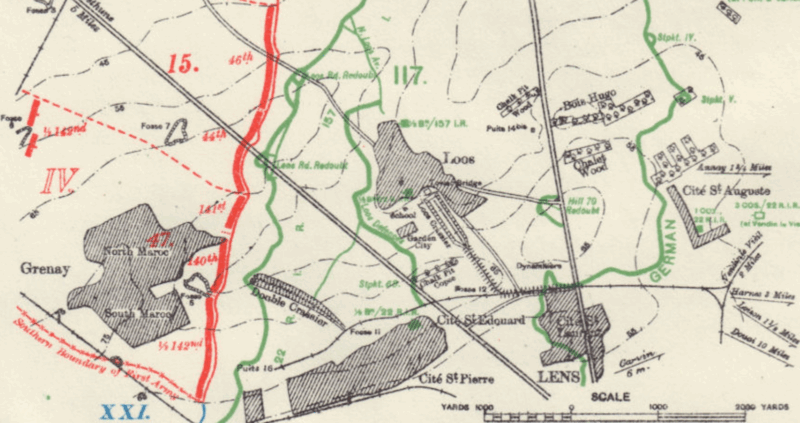
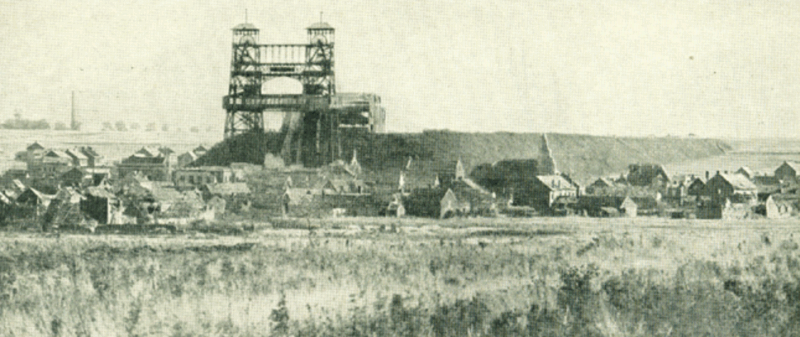
Langholm’s nine fatalities were all on the first day, from five different regiments:
- 7th Division
- 20th Brigade
- 2nd Border Regiment
- 20th Brigade
- 15th (Scottish) Division
- 44th Brigade (Highland regiments)
- 9th Black Watch
- 10th Gordon Highlanders
- 46th Brigade
- 7th KOSB
- 44th Brigade (Highland regiments)
- 24th Division
- 72nd Brigade
- 8th Royal West Surrey (‘8th Queens’)
- 72nd Brigade
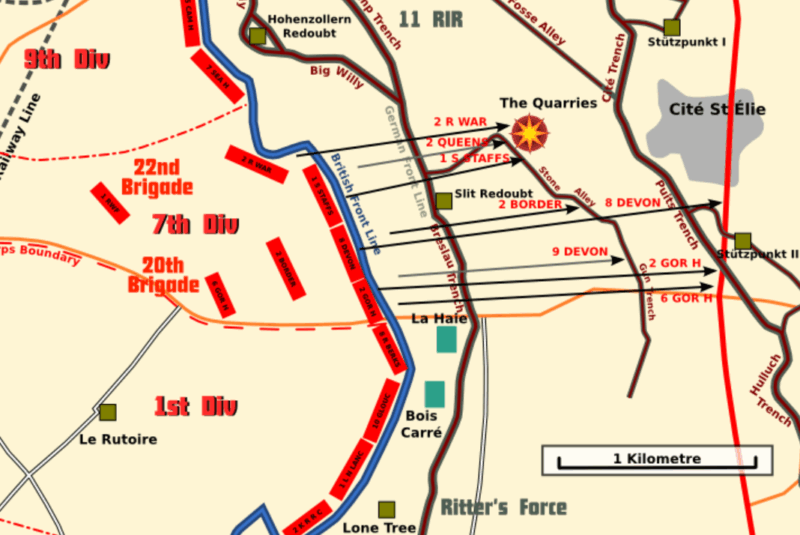
7th Division
The 7th Division, including 2nd Border Regiment, managed to penetrate the German barbed wire and take a number of trenches. This was partly due to Private Arthur Vickers of 2nd Royal Warwickshire cutting the wire while standing up in full view of the enemy, for which he was awarded the Victoria Cross.
Died
| Date | Surname | Forenames | Event | Unit | No. | Rank | Age | Address | Memorial |
|---|---|---|---|---|---|---|---|---|---|
| 25th Sep | Thomson | Frank | Killed in action | 2nd Border Regiment | 4970 | Private | 22 | Caroline Street | Loos |
Frank Thomson was an apprentice tanner with Charles Paisley. He enlisted in the regular army in early 1914 and was a bomb (grenade) thrower. He was the nephew of William Thomson, woollen drawer, his next of kin. Prior to enlisting, he lived with his uncle William and aunt Jessie at 17 Eskdale Place. He is listed in the South United Free Church‘s Roll of Honour.
15th Division
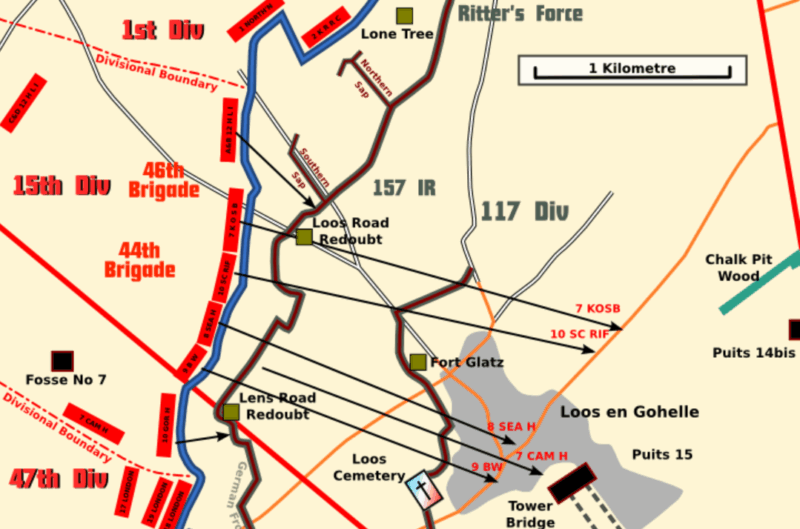
The 44th Brigade, including 9th Black Watch and 10th Gordon Highlanders, managed to advance into Loos. There they reduced German resistance through the day, partly with the help of a 17-year old local girl called Emilienne Moreau, who pointed out key German locations and took part in the offensive herself, eliminating a couple of enemy threats with grenades and a pistol.
The 46th Brigade, like others, was badly affected by Britain’s own chlorine gas, which drifted back over its own lines. Nevertheless, 7th KOSB, spurred on by their piper Daniel Laidlaw (see below), used grenades to destroy the Loos Road machine gun nests and proceeded into the village.
Despite the gas, 7th KOSB piper Daniel Laidlaw climbed up onto the parapet and walked up and down the trench, playing his bagpipes. This had a remarkable effect, prompting a charge forwards. He was badly injured in both legs but continued to play, and was later awarded the Victoria Cross.
| Date | Surname | Forenames | Event | Unit | No. | Rank | Age | Address | Memorial |
|---|---|---|---|---|---|---|---|---|---|
| 25th Sep | Borthwick | Joseph | Killed in action | 10th Gordon Highlanders | S/4669 | Private | 19 | Henry Street | Loos |
| 25th Sep | Comrie | John | Killed in action | 9th Black Watch | S/4506 | Private | 32 | Eskdale Place | Loos |
| 25th Sep | Elliot | William | Killed in action | 7th KOSB | 13833 | Private | 33 | Eskdaill Street | Loos |
| 25th Sep | Malcolm | John | Killed in action | 7th KOSB | 16654 | Private | 20 | 14 Elizabeth Street | Loos |
| 25th Sep | Scott | Isaac | Killed in action | 7th KOSB | 15696 | Private | 26 | Knox’s Buildings | Loos |
| 25th Sep | Scott | James | Killed in action | 7th KOSB | 2nd Lieut | 19 | Kilncleuch | Loos | |
| 25th Sep | Thomson | David | Killed in action | 7th KOSB | 15705 | Corporal | 24 | Drove Road | Loos |
Joe Borthwick was a warehouseman at Ford Mill, the son of James, a tanner. He was originally reported missing. Fellow Langholmite Jock Tudhome saw him shortly before Joe’s death and wrote about the brief encounter in a letter home (see 25th September in the Diary).
John Comrie was also a Ford Mill employee, a power loom tuner. He and his wife Jane had nine children, three of whom died in infancy. Their youngest surviving child is called Bertha Roeber Comrie, probably after a German-born nurse at the Thomas Hope Hospital (see 25th September in the Diary).
William Elliot was a wool sorter at Buccleuch Mill, the son of John, also a wool sorter at the same mill. The E&L reported that he was a ‘tall, well set-up young man, and was noted for his prowess with the bat on the cricket field. He leaves a widow [Elizabeth] and a little boy.’ (E&L, 6 Oct 1915).
John Malcolm was carrying a tank of explosive material that was hit by shrapnel. He was an apprentice joiner with James Telford in Parliament Square, The E&L commented that he was a ‘very quiet unassuming lad, and a great favourite with everyone. He took an interest in athletics, and was a playing member of Langholm Rugby Football Club‘ (E&L, 6 Oct 1915). His father was an elementary school teacher in Eskdalemuir. His elder brother James, who was employed by William Milroy, ironmonger, was wounded through the right hand.
Isaac Scott was the youngest of Sarah Scott’s five soldier sons (see 12th May in the Diary). He worked at Waverley Mill.
James Scott, known as ‘Mac’, was a machine gun officer, the son of Captain James Scott, late of Kilncleuch and former owner of Kilncleuch mill. James senior recently became political secretary to Samuel Samuel, MP for Wandsworth. James junior’s older brother John died of wounds on 15th November 1914.
David Thomson was a hairdresser’s apprentice with James Barr in Langholm, then a worker in the Singer sewing machine factory in Clydebank, Glasgow.
24th Division
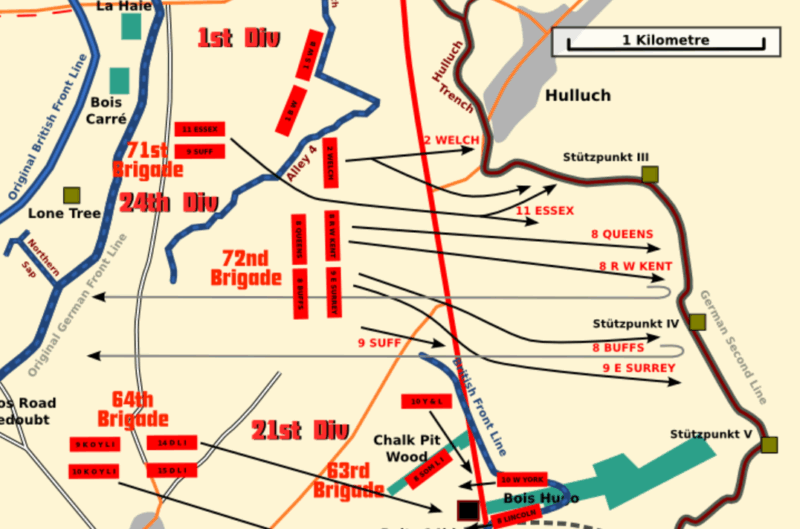
8th Royal West Surrey (‘8th Queens’) supported 8th Royal West Kent in an attack from 11 am on the area between Stützpunkt III and IV, on the right of the map below. By 1 pm they had almost reached the German barbed wire but were severely depleted by machine gun fire and artillery and had to retreat.
| Date | Surname | Forenames | Event | Unit | No. | Rank | Age | Address | Memorial |
|---|---|---|---|---|---|---|---|---|---|
| 25th Sep | MacKnight | James | Killed in action | 8th Royal West Surrey | G/2676 | Corporal | 37 | London (formerly Eskdaill Street) | Loos |
James MacKnight was formerly an apprentice to Robert Scott, printer, and a member of Chalmers Church. His father was a dyer. He moved to London, where he was a linotype operator. He was originally reported missing, then killed.