17th April – 7th May 1915
Hill 60 was a spoil heap from a railway cutting near Ypres, captured by Germany in November 1914. In March and early April 1915, English and Welsh miners dug tunnels into the hill and placed six large sets of explosives in them. They were detonated at 7.05 pm on Saturday 17th April 1915, enabling the hill to be captured by the 13th Infantry Brigade (incorporating 2nd KOSB) of the 5th Infantry Division. However, the Germans regained the hill on 5th May and retained it until June 1917.
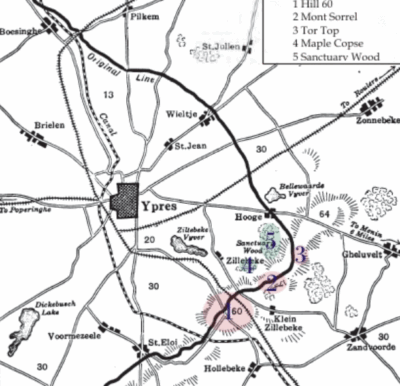
Below is a first-hand account from Private David Douglas, a Langholm stonemason with the KOSB, writing to mill owner Arthur Bell, who regularly sent him copies of the E&L:
I received your paper. It is very welcome, as we don’t see many papers here. I am going to give you my first experience of the firing-line. We had a few days’ rest after landing, then we took [the] train up to about 15 miles from the firing-line, and had to march the rest. We were a tired lot when we arrived at [censored], as we were in full marching order. Then we went into the trenches the next night, and were there eight days. It is a constant fire night and day, but the danger is from their snipers, as they are always on the watch for a head appearing above the trench, and I can tell you your number is up, as they are all dead shots, almost all our men being shot in the head. On Easter Sunday we got a taste of their terrible trench mortars and grenades, and I can tell you I don’t want to go through the same again. But we were relieved that night.
The fellows who relieved us got the same dose, but they lost a lot of men in some of the trenches. We are only about thirty yards from the German trenches. We had another fight on Sunday night, taking an important place from the enemy, but you will see all about it in the papers. Our regiment played an important part in the taking of the hill, but I am afraid we lost heavily both in officers and men. The regiment was thanked by the General (and he does not pay compliments for nothing) for the gallant way the Borderers fought and worked. I could tell you more, but it is too blood-curdling.
E&L, 28 Apr 1915