1. Introduction
In Scotland, annual valuation rolls provided lists of properties in burghs and ‘landward’ (non-burgh) areas of counties, from 1855 to 1974. They indicated each building and piece of land, showing the proprietor, tenant and occupier. They also gave a rateable value which was used to determine the annual rates paid by the proprietor and tenant.
Langholm also has two areas of common land (‘commonties’) which were traditionally available for grazing, building materials and peat.
2. Property records and valuation
The year for property valuation purposes in Scotland was from 15th May to 14th May. Property valuations were used to calculate rates payable by proprietors and tenants. The cycle was derived from Whitsunday (‘Whitsun’ or Pentecost), which the church calendar sets as the seventh Sunday after Easter. This is a changing date each year but Whitsun for property purposes was fixed legally as 15th May.
Many properties were let on the basis of the valuation year which influenced the annual or six-monthly hiring cycle for some businesses, particularly farms, with employment from Whitsun or Martinmas (November). Towns such as Dumfries and Hawick would hold hiring fairs for their areas.
Tenant farmers might retain their tenancy for a number of years but if they decided to end it, there could be a large ‘displenishment sale’ (stock clearances) of livestock and equipment.
3. Valuation roll 1915
The distribution of the type of property in the 1915 valuation roll for Langholm parish was as follows:
| Type of property* | Total | Notes |
|---|---|---|
| Building | 1158 | Includes accompanying land |
| Land | 186 | E.g. grazing, garden lots |
| Farm | 15 | Includes farm buildings |
| Other | 8 | E.g. telegraph wires, water sources |
| 1367 |
* As used by current analysis; not specified in the valuation roll.
Many of the properties in the New Town, developed by the 3rd Duke of Buccleuch, were originally available with a plot of land for a garden or grazing; some of these are listed separately from the house in the valuation roll.
There were also numerous other plots around the town for grazing. Many local adverts sought a housemaid who was also able to milk a cow.
Some properties of interest in the valuation roll are:
- An armoury in the middle of a residential area.
- An ash depot and a stone depot.
- An auction mart.
- Five plots for coal storage next to the railway station, owned by merchants.
- A curling pond.
- A skating pond.
The majority of proprietors owned more than one property in the parish. The following chart excludes the Duke of Buccleuch (248 properties) and Rev David Maxwell (70).
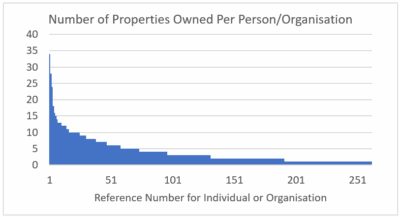
Owners of over 10 properties per person were as follows:
| Owner | Occupation | Properties | Comments |
|---|---|---|---|
| Duke of Buccleuch | Property owner | 248 | Including 13 farms and 123 plots of land. |
| Rev David Maxwell | Church of England vicar, property owner | 70 | Including 2 farms and 31 plots of land. |
| Mary Johnstone | Spinster | 34 | Laurieknowe House, Maxwelltown. Sister of Andrew Johnstone, former Langholm town clerk. Andrew died single in 1906. |
| James Scott & Sons | Woollen mill owners | 28 | Waverley mill. |
| Matthew Knox | Joiner | 24 | Three other properties were owned by the representatives of his wife Ellen who died in 1912. |
| Robert Moffat | Merchant | 18 | Draper, grocer and bacon curer in Rowanburn, Canonbie. Justice of the Peace and chair of the District Committee. |
| John Chadwick | Inn owner | 16 | St Ronan’s Lodge, Innerleithen. |
| Sara Latimer | Spinster | 15 | Daughter of ironmonger David Latimer who died in 1908. |
| Joseph Turnbull’s heritable creditor | Slater | 14 | Mortgaged. All but one of the properties were in the High Street. Joseph’s father was a shoemaker. |
| Walter Wilson | Bookseller | 13 | Also local newspaper publisher, stationer and shipping company agent. |
| Robert Oliver | Bank messenger | 13 | Retired. Brother-in-law of Matthew Knox (above). |
| Jemima Little nee Murray | Widow | 13 | Widow of wool spinner Andrew Murray. Mother of Andrew Little, assistant to Walter Wilson (above). |
| Reid & Taylor | Woollen mill owners | 12 | Mill properties; houses in Mary Street. |
| Margaret Telfer nee Martin | Widow | 12 | Widow of Thomas Telfer, builder, who died in 1907. Properties in Henry and Caroline Streets. |
| Margaret and Jane Hotson | Spinsters | 12 | Daughters of John Hotson, builder, who died in 1911. |
| George McCleary | Commercial traveller | 12 | Former woollen warehouse manager. |
| Arthur Bell | Woollen mill owner | 11 | Buccleuch mill. |
| James Bell | Plasterer | 11 | Unrelated to Arthur Bell above. |
| 554 |
Many owners of multiple properties were tradespeople and their heirs. There was a significant amount of new construction in the area in the late 1800s and early 1900s and properties were considerably more affordable in relation to income than in later decades. For example, Matthew Knox, joiner, worked on, amongst other projects:
- Murray House, High Street, 1893
- Thomas Hope Hospital, 1894-1896
- Kilncleuch mill, 1895
4. Common land
Scotland had large areas of common land, mostly in the form of ‘commonties’, which could be accessed by all local people for grazing, building materials and fuel such as wood or peat. Boggy peat areas of commonties were known as ‘common moss’.
However, many of these were divided up and passed into private ownership after the Division of Commonties Act 1695. In the Langholm area, most of the commonty was divided in 1759 between the Duke of Buccleuch, John Maxwell of Broomholm and John Little. An area just to the north of the town, called the Kilngreen, and an area of common moss to the east of the town, remained as commonties.
The patrolling of these areas to ensure no encroachment is the basis of the annual Common Riding, with sods of earth being cut symbolically in various locations to indicate the exercise of traditional rights.
< Alcohol … Voting rights >